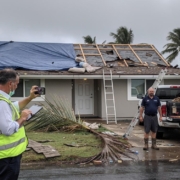
Storm Damage Insurance Hawaii: Ensuring Quick Recovery

Storm Damage Insurance Hawaii: Ensuring Quick Recovery

Hawaii’s storm season brings real risks to your home and finances. At Carr’s Insurance Agency, we know that storm damage insurance in Hawaii isn’t just about having a policy-it’s about understanding what actually protects you when a hurricane or tropical storm hits.

This guide walks you through coverage options, claim filing steps, and practical ways to strengthen your property before the next storm arrives.

What Does Hawaii Storm Insurance Actually Cover

Hawaii’s storm threats are specific and severe, which means your coverage needs to be equally specific. Hurricane Iniki struck Kauai on September 11, 1992, with sustained winds around 130 mph and caused around $3.1 billion in property damage. That storm exposed a hard truth: standard homeowners policies in Hawaii often leave massive gaps when hurricanes or tropical storms hit.

Most basic homeowners policies cover wind damage from storms, but they typically exclude or severely limit coverage for water damage, storm surge, and flooding-the three biggest culprits in Hawaiian hurricane losses. Standard policies also rarely cover the secondary damage that follows, like mold remediation or temporary housing costs during repairs. Too many homeowners face these gaps after a storm arrives, when it’s far too late to add protection.

Wind Damage vs. Water Damage

Your homeowners policy likely covers wind damage, but the devil lives in the details. Wind-driven rain that enters through roof damage or broken windows typically falls under water damage exclusions, not wind coverage. This distinction matters enormously in Hawaii, where storm surge and heavy rainfall accompany most hurricanes.
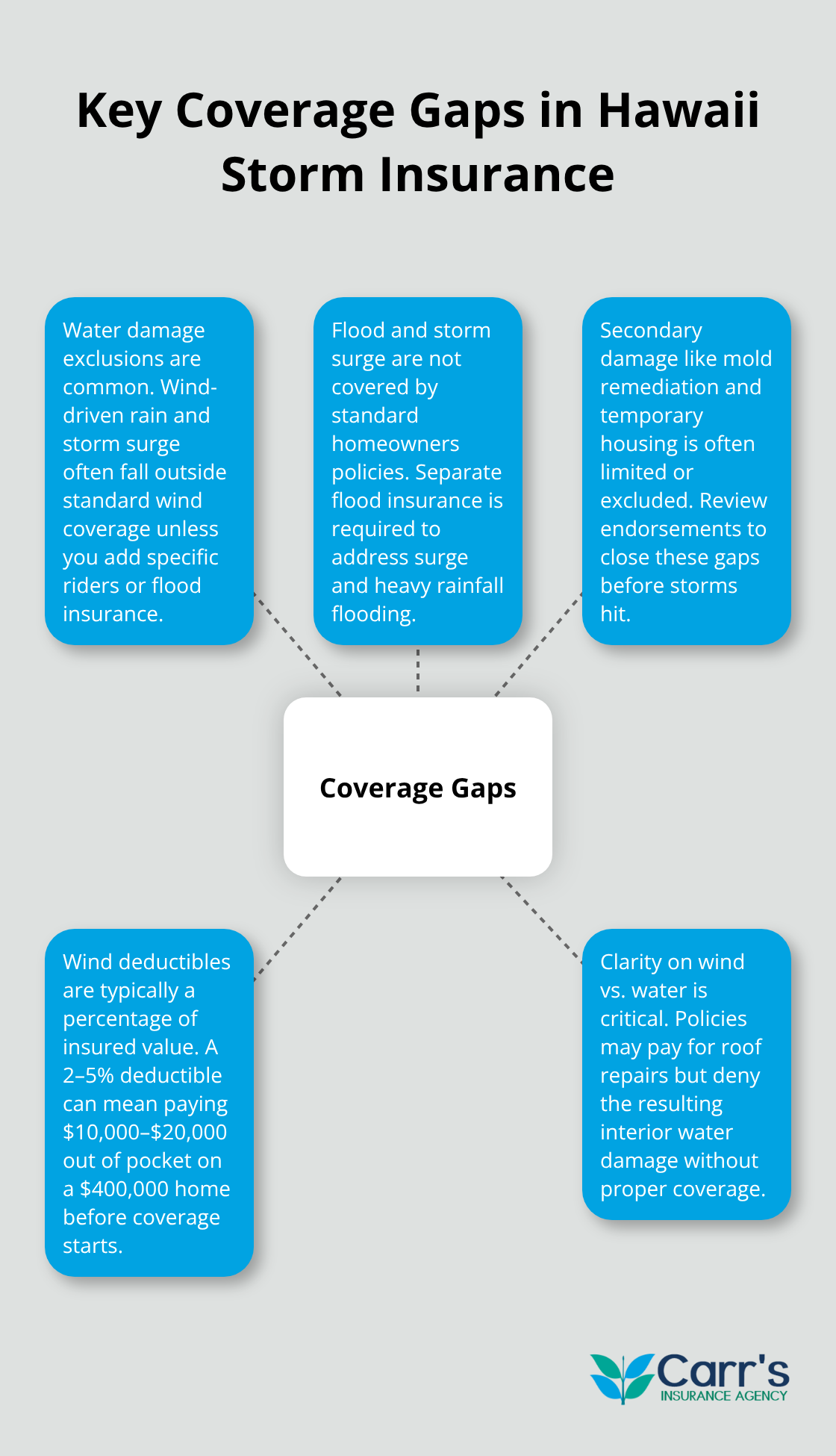
Hub-and-spoke diagram illustrating common coverage gaps in Hawaii storm insurance - Storm damage insurance Hawaii

NOAA records show that past Hawaiian hurricanes like Iwa in 1982 and Iniki in 1992 caused catastrophic coastal damage through surge and flooding, not wind alone. Many homeowners discovered their policies paid for roof repairs but refused claims for the water that poured through those damaged roofs. You need explicit water damage or flood coverage added to your policy to address this gap.

Standard policies also cap wind deductibles at 2 to 5 percent of your home’s insured value, meaning a deductible could easily exceed $10,000 to $20,000 on a $400,000 home. That’s a significant out-of-pocket cost before insurance kicks in.

What You Must Add to Your Coverage

Hawaii-specific storm coverage requires three essential additions: flood insurance through the National Flood Insurance Program, water damage riders that cover rain intrusion during storms, and replacement cost coverage rather than actual cash value. Flood insurance stands separate from your homeowners policy and covers storm surge, heavy rainfall flooding, and overflow from nearby waterways.

Replacement cost coverage pays for repairs or replacement at current market prices, while actual cash value deducts depreciation-a critical difference when you rebuild after a hurricane. The topography of Hawaii’s islands funnels and concentrates winds across ridges and channels, increasing destructive force in certain areas.

If your home sits in a high-wind zone or coastal area, you may also need windstorm coverage, which protects against hurricane-force winds but requires a separate policy rider. Coverage limits matter too; many homeowners underinsure their properties, then face massive shortfalls when repair costs exceed their policy limits by thousands of dollars. Understanding these gaps now positions you to file claims effectively when storms strike.

How to File Your Storm Damage Claim Before It’s Too Late

Act Fast After the Storm Hits

The first hours after a hurricane or tropical storm strikes your Hawaii home determine whether your insurance claim succeeds or fails. Your insurance company enforces strict timelines, and Hawaii’s storm season means adjusters get overwhelmed fast. Contact your insurer within 24 to 48 hours of the storm passing, even if you cannot fully assess damage yet. This immediate notification protects your claim and signals to your carrier that you take the loss seriously.
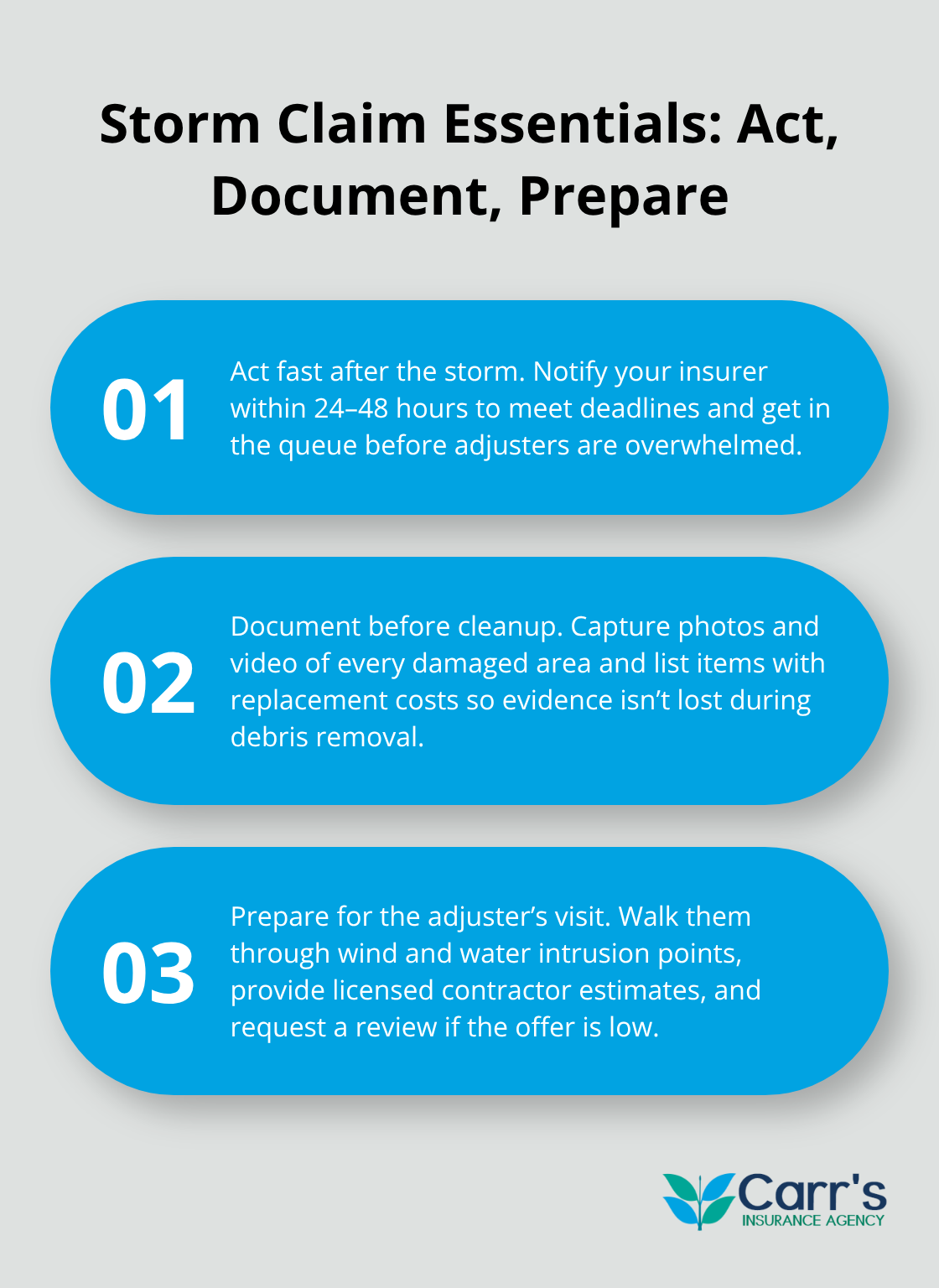
Three key steps to file a Hawaii storm damage claim successfully

Document Everything Before Cleanup Starts

Photograph and video all damaged areas before you touch anything or start cleanup, because once debris removal begins, your evidence vanishes. Your insurer needs to see the damage in its raw state to process your claim fairly. Create a written list of every damaged item with approximate replacement costs, cross-referenced to your photos. Do not rely on your memory weeks later when the adjuster asks what was destroyed. Store all documentation digitally and physically in separate locations, because flooding or additional storms can destroy your records.

Prepare for Your Adjuster’s Visit

Most claim denials in Hawaii stem from inadequate documentation or homeowners filing without understanding what their policy actually covers. When your adjuster arrives, walk them through the property systematically and point out wind damage, water intrusion points, and secondary damage like mold growth or structural issues that emerged after water exposure. Adjusters work fast and handle multiple claims simultaneously, so your organized documentation keeps their attention on your legitimate losses.

Provide your adjuster with repair estimates from licensed contractors, not just your own guesses about costs. Hawaii contractors typically provide free assessments after storms, and obtaining three quotes protects you if your insurer’s estimate seems low. If your adjuster’s settlement offer falls short of your documented losses, request a detailed explanation of their calculation and ask for a second opinion through an independent adjuster or public adjuster. Never accept a settlement that feels incomplete just to speed up the process.

Strengthen Your Position with Professional Help

Your next step involves preparing your property to withstand future storms, which starts with understanding what structural vulnerabilities your home actually has.

Hardening Your Home Against Hawaii’s Storm Season

Hawaii’s building codes lag behind storm science, which means your home probably has structural vulnerabilities that contractors can fix before the next hurricane arrives. The topography of Hawaii’s islands funnels and concentrates winds across ridges and channels, turning certain neighborhoods into wind tunnels that exceed standard design pressures. Start with a structural inspection of your roof attachment, because this single point determines whether your home stays intact or loses its roof during a Category 3 hurricane.

Reinforce Your Roof and Walls

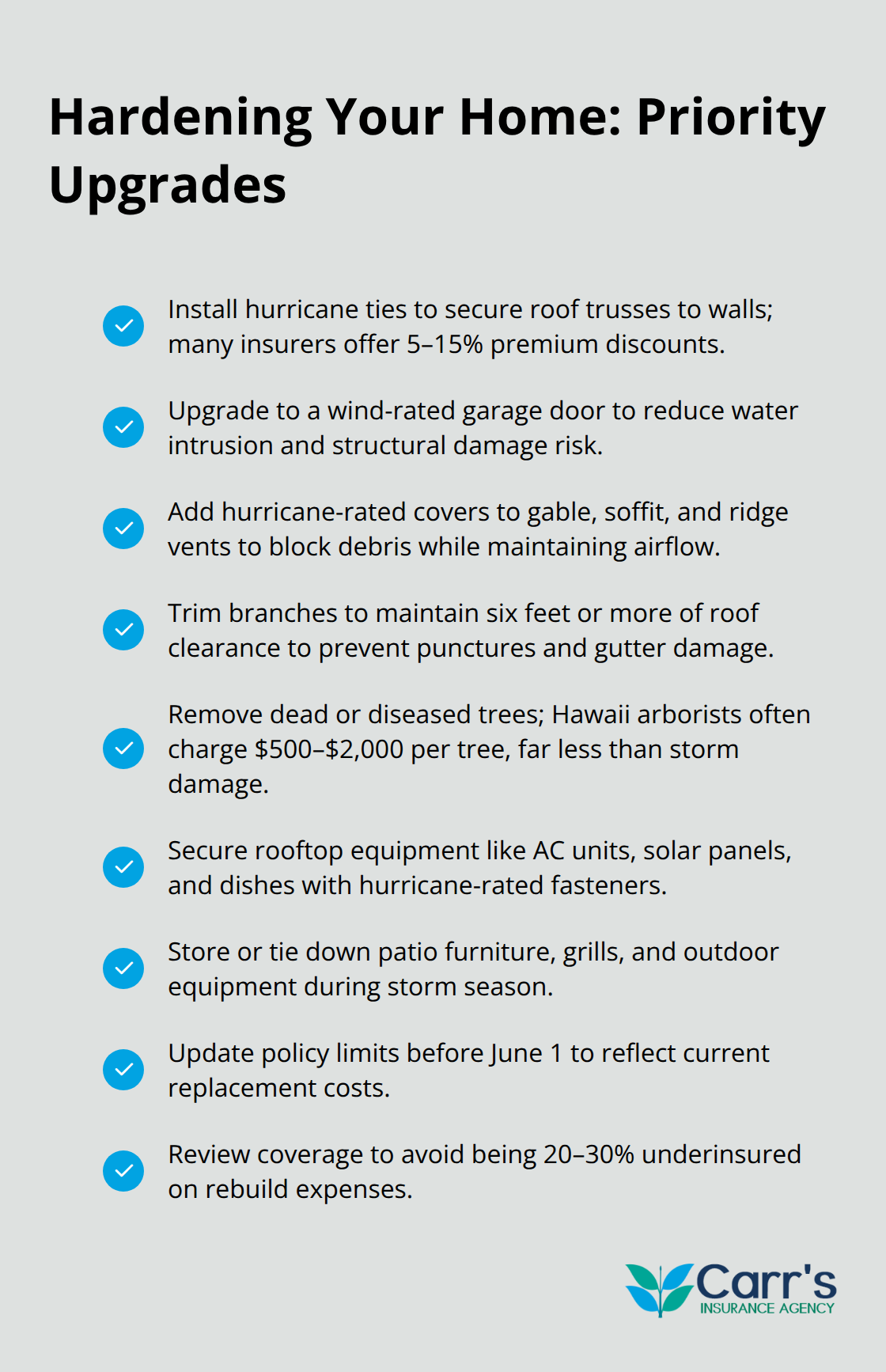
Hurricane ties connect your roof trusses to your walls and cost between $200 and $500 per home. These straps prevent the catastrophic failure that turns a manageable repair into total loss. Your insurance company may offer discounts of 5 to 15 percent if you install these reinforcements, which means the upgrades pay for themselves through premium reductions within two to four years.

Garage doors fail frequently in hurricanes, so replacing a standard garage door with a wind-resistant model costs $1,500 to $3,000 but prevents water intrusion that causes mold, electrical damage, and structural rot. Gable vents, soffit vents, and ridge vents need hurricane-rated covers that maintain ventilation while blocking debris. Your home’s perimeter also matters enormously; concrete block construction resists wind better than wood frame, but older Hawaii homes often have lightweight construction that makes wind-driven debris a major threat to the structure and neighboring properties.
Checklist of practical upgrades to strengthen a Hawaii home for storm season - Storm damage insurance Hawaii

Secure Your Outdoor Environment

Outdoor objects become projectiles in 130-mph winds, so your surroundings matter as much as your home’s structure. Trim tree branches that hang over your roof to six feet or more of clearance, because falling branches penetrate roofs and damage gutters in ways that trigger water intrusion claims. Remove dead or diseased trees entirely; arborists in Hawaii typically charge $500 to $2,000 per tree depending on size and location, and this expense prevents far costlier damage during storms.

Secure air conditioning units, solar panels, and satellite dishes to your roof structure with hurricane-rated fasteners, not standard mounting hardware. Patio furniture, grills, trash cans, and outdoor equipment need storage inside, heavy cable ties, or complete removal during hurricane season. These simple steps prevent your property from damaging neighboring homes when winds turn loose objects into weapons.

Update Your Coverage Before Storm Season

Update your coverage limits and policy details before June 1st, the official start of Hawaii’s hurricane season. Most homeowners underestimate their home’s replacement value by 20 to 30 percent, which leaves them short when contractors quote actual repair costs after a storm. Request a detailed policy review from a local independent agent who understands Hawaii’s specific risks and can compare rates across multiple carriers (Carr’s Insurance Agency, as a locally owned independent broker serving Hawaii since 1990, represents top carriers and provides personalized service to help you find the right coverage and save money).

Final Thoughts

Storm damage insurance in Hawaii protects your financial stability when hurricanes and tropical storms strike your home. Past storms like Hurricane Iniki caused over $2.3 billion in losses on Kauai alone, and Hawaii’s vulnerable building stock means your property faces real risk. Standard homeowners policies leave dangerous gaps, water damage exclusions create false security, and underinsured properties leave owners facing massive out-of-pocket costs after storms pass.

Your preparation strategy must address three concrete areas: understand exactly what your current policy covers and add flood insurance, water damage riders, and replacement cost coverage before hurricane season arrives; physically harden your home through roof reinforcements, garage door upgrades, and tree trimming (these investments reduce damage and often qualify for insurance discounts that offset their cost); and document your property’s condition now, photograph valuable items, and maintain organized records so claims move faster when storms hit. Timing matters enormously-waiting until June to review your coverage means adjusters are already overwhelmed with spring storm claims, waiting until August to trim trees means contractors are booked solid, and waiting until after a hurricane to add flood insurance means your claim gets denied because the policy wasn’t active when the storm struck.

Carr’s Insurance Agency has served Hawaii since 1990 and understands the specific risks your home faces. As an independent broker representing top carriers, we compare rates across multiple insurers and connect you with licensed, locally knowledgeable agents who deliver personalized service. Contact us today to review your storm damage insurance in Hawaii and prepare your home before the next storm season arrives.

Disclaimer: The information provided in this blog is for general informational purposes only and does not constitute legal, financial, or insurance advice. Coverage options, terms, and availability may vary. Please consult with a licensed professional for advice specific to your situation
Hawaii Insured Commercial Vehicles: Why Coverage Matters

Hawaii Insured Commercial Vehicles: Why Coverage Matters

Running a business with commercial vehicles in Hawaii means navigating real risks that most business owners underestimate. Hawaii insured commercial vehicles require more than basic coverage-they need protection tailored to our islands’ specific conditions and legal landscape.

At Carr’s Insurance Agency, we’ve seen too many business owners discover gaps in their coverage only after an accident or claim. The good news is that understanding your options now can save your business from devastating financial losses later.

Why Your Commercial Vehicles Need Real Protection in Hawaii

Hawaii’s Road Environment Demands Serious Coverage

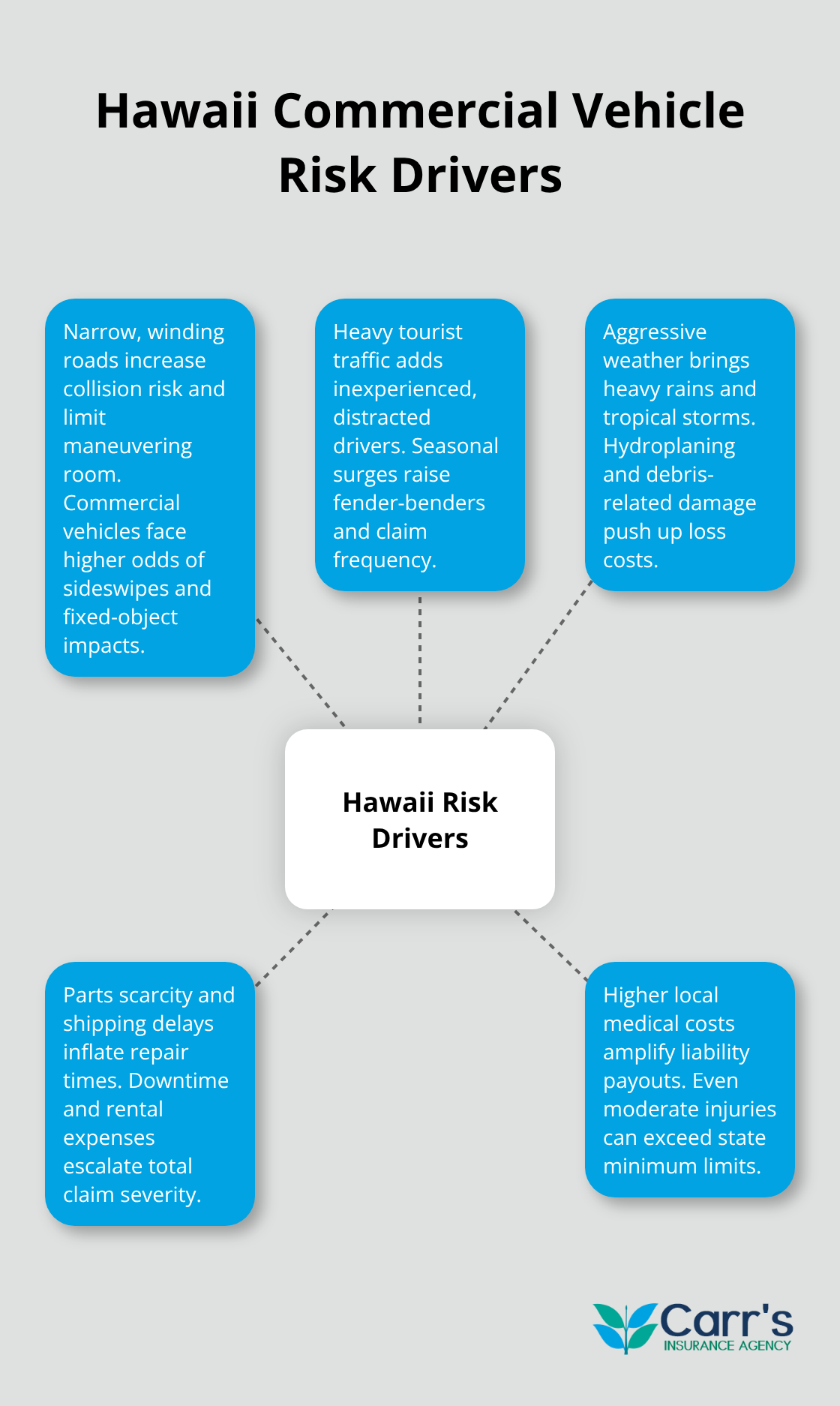
Hawaii’s road environment punishes inadequate coverage in ways mainland business owners rarely face. The combination of narrow roads, heavy tourist traffic, and aggressive weather creates accident rates that demand serious insurance strategies. When your commercial vehicle collides with another vehicle or object here, the damage compounds quickly-repair costs spike due to limited local parts availability and shipping delays from the mainland.

Visual map of key Hawaii-specific risk factors affecting commercial vehicle insurance.

Liability claims escalate faster in Hawaii too, where medical expenses run higher than national averages. You cannot afford to guess at coverage levels or rely on whatever your previous agent recommended. A single serious accident involving your commercial vehicle can expose your company to six-figure claims that exceed state minimums by multiples.

Hawaii’s Legal Minimums Fall Short of Real Protection

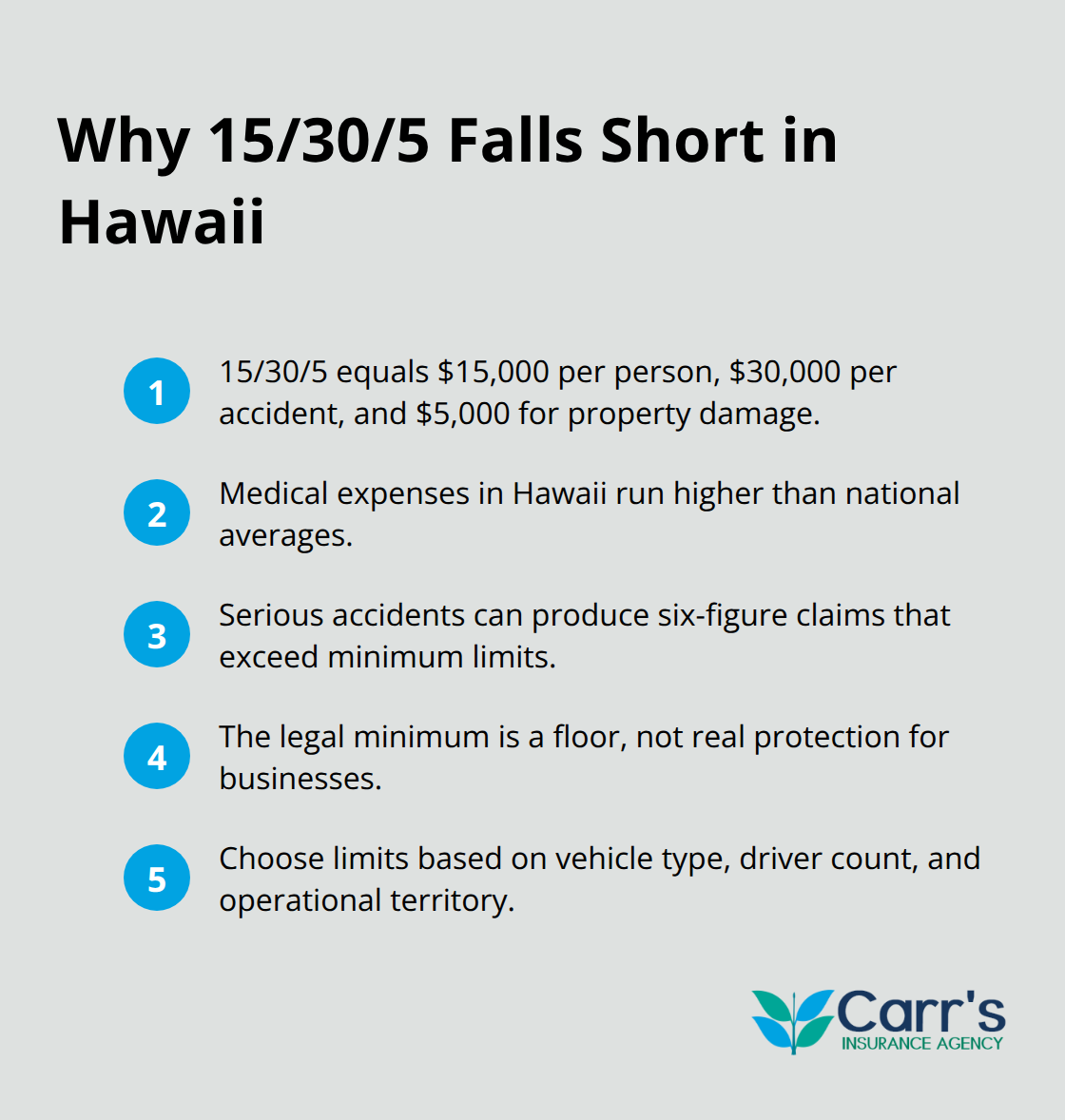
Hawaii requires all commercial vehicles to carry minimum liability insurance of 15/30/5 (bodily injury per person, total bodily injury per accident, and property damage), but this legal floor is dangerously low for actual business protection. The financial exposure extends beyond the accident itself. If your commercial vehicle injures someone or damages property, Hawaii law makes your business liable for damages that often reach significant amounts in serious cases.

Key reasons Hawaii’s legal minimum liability limits are inadequate for real-world claims. - Hawaii insured commercial vehicles

Most business owners severely underestimate their fleet’s actual replacement value, leaving themselves vulnerable when vehicles are totaled. Weather-related claims in Hawaii spike during November through March, when tropical storms and heavy rains cause accidents that standard policies sometimes exclude or limit.

Coverage Gaps That Destroy Unprepared Businesses

Hired and non-owned vehicle coverage-protection for when employees drive rented vehicles or borrow equipment for business purposes-gets overlooked constantly, yet these gaps create massive exposure. Businesses lose coverage protection entirely when they fail to notify their agent after adding a new vehicle to their fleet or changing how vehicles operate. These oversights happen more often than you’d think, and they leave your company completely unprotected at the worst possible moment.

The bottom line is straightforward: commercial vehicle coverage in Hawaii isn’t about meeting legal requirements or checking boxes. Your protection must match Hawaii’s specific risks and your actual operational needs. Understanding what types of coverage actually exist-and which ones your business truly needs-separates companies that survive claims from those that face financial ruin.

What Coverage Options Actually Protect Your Hawaii Fleet

Standard Commercial Auto Coverage and Its Real Limits

Commercial auto insurance in Hawaii splits into distinct categories, and choosing between them determines whether your business survives a major claim or faces bankruptcy. Standard commercial auto policies cover liability, collision, and comprehensive damage, but Hawaii’s specific risks demand you understand exactly what each component covers and where gaps emerge. Liability coverage pays for injuries or property damage your vehicle causes to others, collision covers damage to your vehicle from accidents, and comprehensive handles weather, theft, and vandalism. Most business owners incorrectly assume these three components work together seamlessly, but they operate independently with separate deductibles and limits.

You cannot afford to focus only on meeting Hawaii’s legal minimum of 15/30/5 instead of calculating your actual risk exposure based on vehicle type, driver count, and operational territory.

Specialty Coverage for Tow Trucks and Service Vehicles

Specialty coverage becomes non-negotiable if your business operates tow trucks, service vehicles, or mobile equipment. Tow truck operators face unique exposures that standard commercial auto policies either exclude or severely limit, including coverage for tools, equipment, and the towed vehicle itself. Service vehicles carrying expensive tools or diagnostic equipment need inland marine coverage layered over basic auto policies, since standard commercial auto won’t compensate you for stolen or damaged equipment.

Business Owner Policies and Cost Savings

Business owner policies combine commercial auto with general liability, property coverage, and other protections into one package. However, bundling only saves money if the package actually covers your specific operations. Many business owners discover after a claim that their bundled policy excluded hired vehicle coverage or non-owned vehicle liability, forcing them to pay losses directly from cash flow.

The Hidden Exposure of Hired and Non-Owned Vehicles

If your business uses rented vehicles for deliveries or temporarily borrows equipment vehicles, hired and non-owned vehicle coverage is not optional. This gap exposes your company to significant liability when employees drive vehicles your business doesn’t own. The decision about which coverage structure works for your fleet requires honest assessment of every vehicle type you operate, every way employees use vehicles for business purposes, and every scenario where you might need protection-which brings us to the coverage gaps that destroy unprepared businesses.

Common Coverage Gaps Business Owners Miss

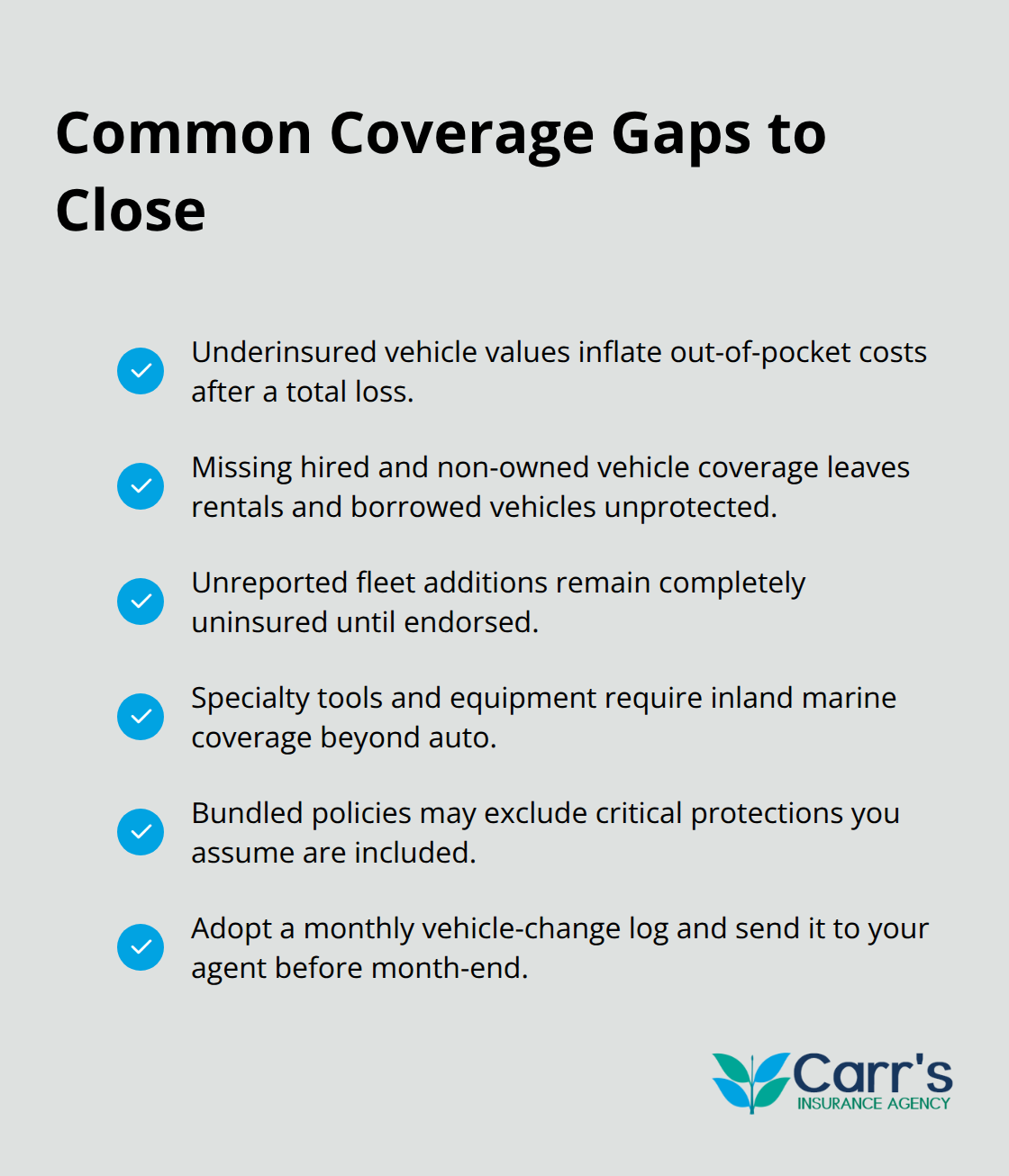
Underinsuring Vehicle Value Costs You Thousands

Most business owners in Hawaii drastically underestimate what their commercial vehicles are actually worth, then shock themselves when a total loss claim arrives and their insurance payout falls thousands of dollars short of replacement costs. You need to physically inspect each vehicle, research current market replacement values for that exact make and model in Hawaii, then add 15 to 20 percent for the reality that parts and labor cost significantly more on the islands than on the mainland. The National Association of Insurance Commissioners reports that underinsured vehicles represent one of the costliest mistakes businesses make, yet it happens because owners rely on decade-old estimates or what they originally paid for a vehicle.

A 2015 Ford van that cost $28,000 new might now cost $19,000 to replace with equivalent mileage, or it might cost $24,000 depending on current market conditions-you cannot guess at this number. Pull quotes from local Hawaii dealers, check current auction prices through NADA Guides, and document everything so your agent can set accurate coverage limits that actually reflect what you’d spend to get back on the road after a total loss.

Hired and Non-Owned Vehicles Create Uninsured Exposure

If your employees ever drive rental vehicles for business deliveries, borrow a colleague’s truck to pick up supplies, or operate equipment vehicles that your business doesn’t own, your standard commercial auto policy likely provides zero protection for those situations. This gap catches business owners completely off guard because they assume their commercial auto coverage travels with their employees, but it doesn’t-it only covers vehicles your business owns or leases.

Checklist of frequent commercial auto coverage gaps for Hawaii businesses. - Hawaii insured commercial vehicles

A delivery driver using a rented vehicle involved in an accident that injures someone means your business faces liability claims that your policy won’t cover, forcing you to pay damages directly from cash reserves. Hired and non-owned vehicle coverage eliminates this catastrophic exposure, and it becomes mandatory if your operations involve any scenario where employees operate vehicles outside your direct ownership.

Fleet Changes and Policy Neglect Leave Gaps

Adding new vehicles to your fleet without notifying your agent leaves those vehicles completely uninsured, a mistake that happens repeatedly because owners assume coverage automatically expands or they simply forget to make the call. If your business purchases an additional service vehicle, brings in a used truck from another location, or temporarily adds equipment for seasonal work, your existing policy does not cover those additions until you formally notify your agent and they issue an endorsement.

Insurance claims investigators look specifically for this type of coverage lapse when investigating accidents, and they will deny claims for vehicles not listed on your active policy. You must establish a monthly routine where you document every vehicle change (additions, removals, or operational changes like converting a personal vehicle to business use) and submit that list to your agent before month-end, creating a paper trail that protects your business and keeps your coverage current with your actual operations.

Final Thoughts

Assessing your commercial vehicle coverage needs starts with a brutally honest inventory of every vehicle your business operates and exactly how each one gets used. Document the make, model, year, and current replacement value for each vehicle, then list every scenario where employees might drive vehicles you don’t own or operate equipment outside your direct control. This inventory becomes your roadmap for identifying which coverage types you actually need versus which ones you can skip.

Hawaii insured commercial vehicles require coverage decisions based on your specific operational reality, not generic templates or what competitors carry. A tow truck operator faces completely different risks than a service contractor, who faces different risks than a delivery business (and your coverage structure must match your actual exposures). Having detailed conversations with someone who understands Hawaii’s insurance landscape and your business operations transforms your protection from guesswork into strategy.

Contact Carr’s Insurance Agency to schedule a coverage review with an agent who can assess your fleet, identify gaps in your current protection, and build a strategy that actually covers your business. Waiting until after an accident or claim to discover coverage gaps costs far more than investing time now to get protection right. Your business assets deserve protection that matches Hawaii’s real risks.

Disclaimer: The information provided in this blog is for general informational purposes only and does not constitute legal, financial, or insurance advice. Coverage options, terms, and availability may vary. Please consult with a licensed professional for advice specific to your situation
Business Hurricane Insurance Hawaii: Protecting Your Assets

Business Hurricane Insurance Hawaii: Protecting Your Assets

Hawaii’s hurricane season brings real threats to businesses across the islands. Between June and November, tropical storms can devastate property, halt operations, and drain revenue in days.

We at Carr’s Insurance Agency know that standard business insurance often leaves gaps when hurricanes strike. Business hurricane insurance in Hawaii fills those gaps, protecting your assets, inventory, and income when storms hit hardest.

Why Hawaii’s Location Makes Hurricanes a Business Threat

Hawaii’s Position in the Pacific Hurricane Path

Hawaii sits directly in the path of tropical systems that form across the central Pacific. The state’s hurricane season runs from June through November, with peak activity occurring in August and September. On average, about 4 to 5 tropical systems occur each year within 1500 miles or so of Hawaii, though indirect impacts from passing storms occur much more frequently.

Even storms passing well away from the islands bring destructive winds, heavy rain, and flooding that damage property and disrupt operations. The state’s isolation in the middle of the ocean means that once a hurricane forms and heads toward Hawaii, you cannot move your inventory, equipment, or physical location to safety.

The Real Cost of Past Hurricanes

Historical data shows what hurricanes actually cost business operations. Hurricane Iniki in 1992 caused over $3 billion in damage across the islands and remains one of the costliest hurricanes in Hawaiian history. More recently, Hurricane Lane in 2018 brought unprecedented rainfall to parts of Hawaii and caused widespread flooding that affected businesses for weeks afterward.

Businesses without proper hurricane coverage faced months of lost revenue and repair delays because standard commercial policies simply do not account for the specific risks that tropical systems create. The frequency and unpredictability of storms means that Hawaii businesses cannot rely on luck or hope that the next major hurricane will miss.

Intensifying Storm Patterns Threaten Your Bottom Line

Over the past two decades, the intensity of Pacific hurricanes has increased, with more storms rapidly strengthening as they approach warmer waters near Hawaii. This trend directly affects your bottom line because stronger storms mean greater damage potential and longer recovery periods for businesses without comprehensive protection.

The combination of Hawaii’s geographic exposure, historical hurricane impacts, and intensifying storm patterns creates a clear reality: your business faces real hurricane risk that standard insurance policies do not address. Understanding what business hurricane insurance actually covers becomes the next step in protecting your assets and operations.

What Business Hurricane Insurance Actually Covers

Property Damage Protection for Your Building and Fixtures

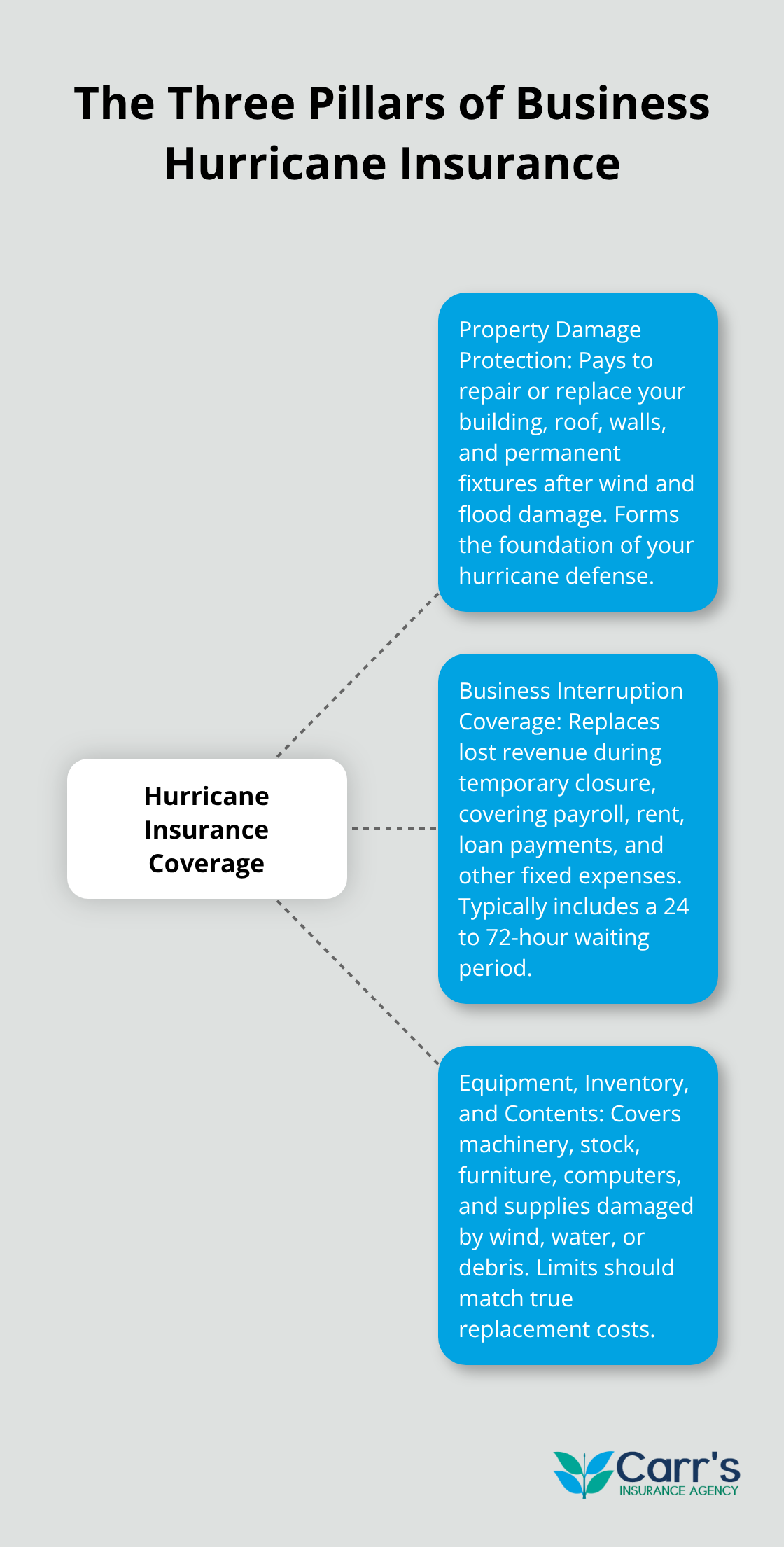
Business hurricane insurance in Hawaii protects three critical areas that standard commercial policies either exclude or severely limit. Property damage coverage pays for repairs or replacement of your building structure, roof, walls, and permanent fixtures when hurricane winds and flooding destroy them. This protection forms the foundation of your hurricane defense-it is not optional in Hawaii.

Hub-and-spoke chart showing property damage, business interruption, and contents coverage as the three pillars of business hurricane insurance in Hawaii. - Business hurricane insurance Hawaii

A standard commercial property policy might cover wind damage to your roof but excludes flood damage entirely, even though hurricanes bring both simultaneously.

Business Interruption Coverage Replaces Your Lost Revenue

Business interruption coverage replaces lost revenue when a hurricane forces you to close temporarily, covering payroll, rent, loan payments, and other fixed expenses that continue even when your doors remain shut. According to the National Association of Insurance Commissioners, businesses without interruption coverage fail at twice the rate of those with it after major disasters. This coverage has waiting periods, typically 24 to 72 hours, which means you absorb losses during the initial critical hours after a storm hits. If you operate a retail shop with $50,000 in inventory and a restaurant with $8,000 monthly rent, a two-week closure costs you $16,000 in rent alone before counting lost sales.

Equipment, Inventory, and Contents Protection

Equipment, inventory, and contents protection covers everything inside your building-machinery, stock, furniture, computers, and supplies-that gets damaged or destroyed by wind, water, or debris. The gap between what you think you have and what you actually have is where businesses in Hawaii get hurt most. Coverage limits must reflect your actual replacement costs, not your best guess. A professional property appraisal establishes accurate limits rather than leaving you underinsured and facing partial recovery after a major hurricane.

Deductibles and Premium Decisions

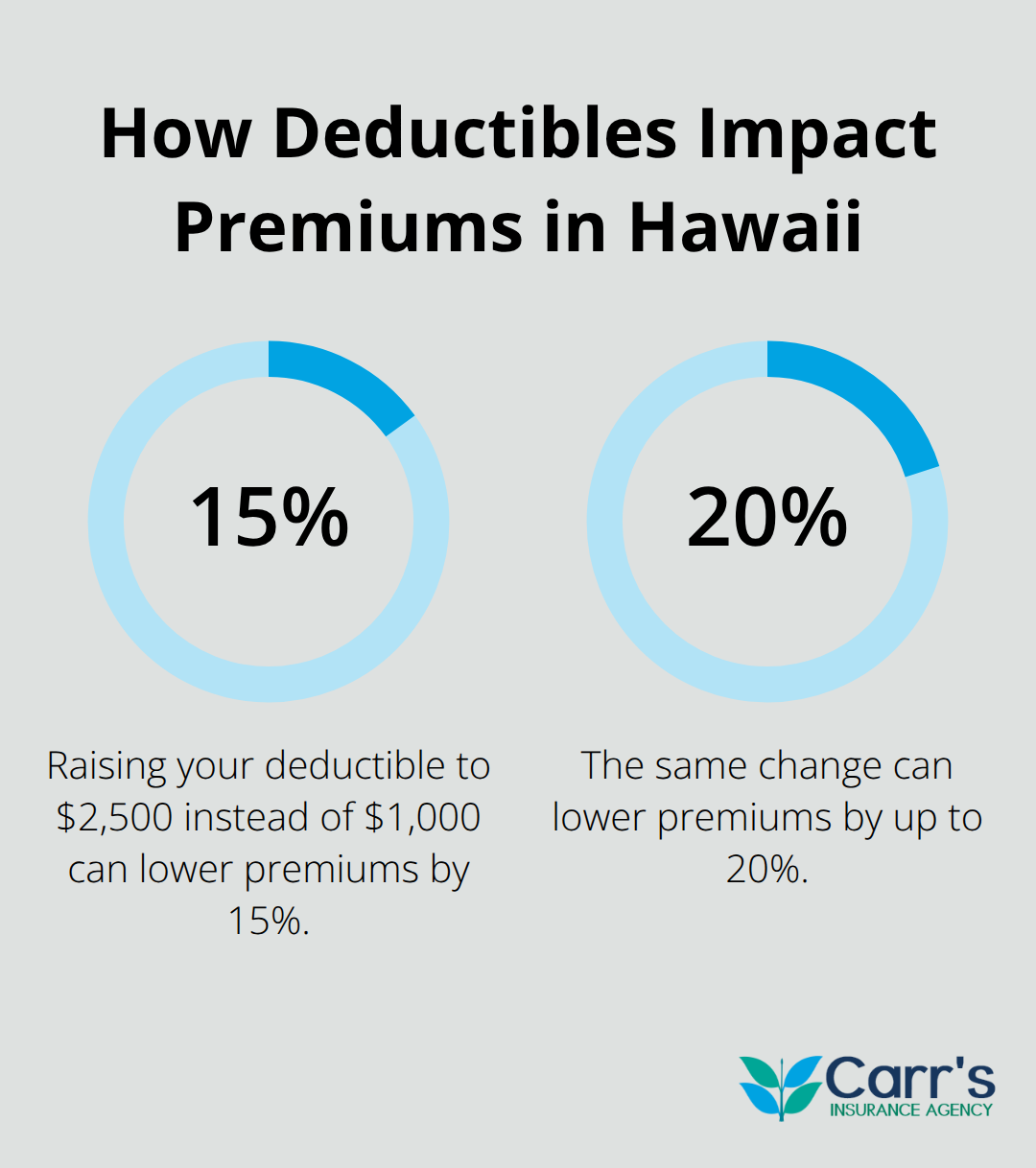
Deductibles matter significantly in Hawaii-choosing a $2,500 deductible instead of $1,000 can lower your premium 15 to 20 percent, but that decision determines how much you pay out of pocket when damage occurs. Your choice between lower premiums and higher out-of-pocket costs depends on your cash reserves and risk tolerance. Once you understand what your policy actually covers, the next step involves selecting the right coverage limits and deductibles for your specific business operations.

Percentage chart showing that raising a deductible from $1,000 to $2,500 can lower premiums by 15% to 20% in Hawaii. - Business hurricane insurance Hawaii

How to Choose the Right Hurricane Insurance Policy

Calculate Your True Replacement Costs

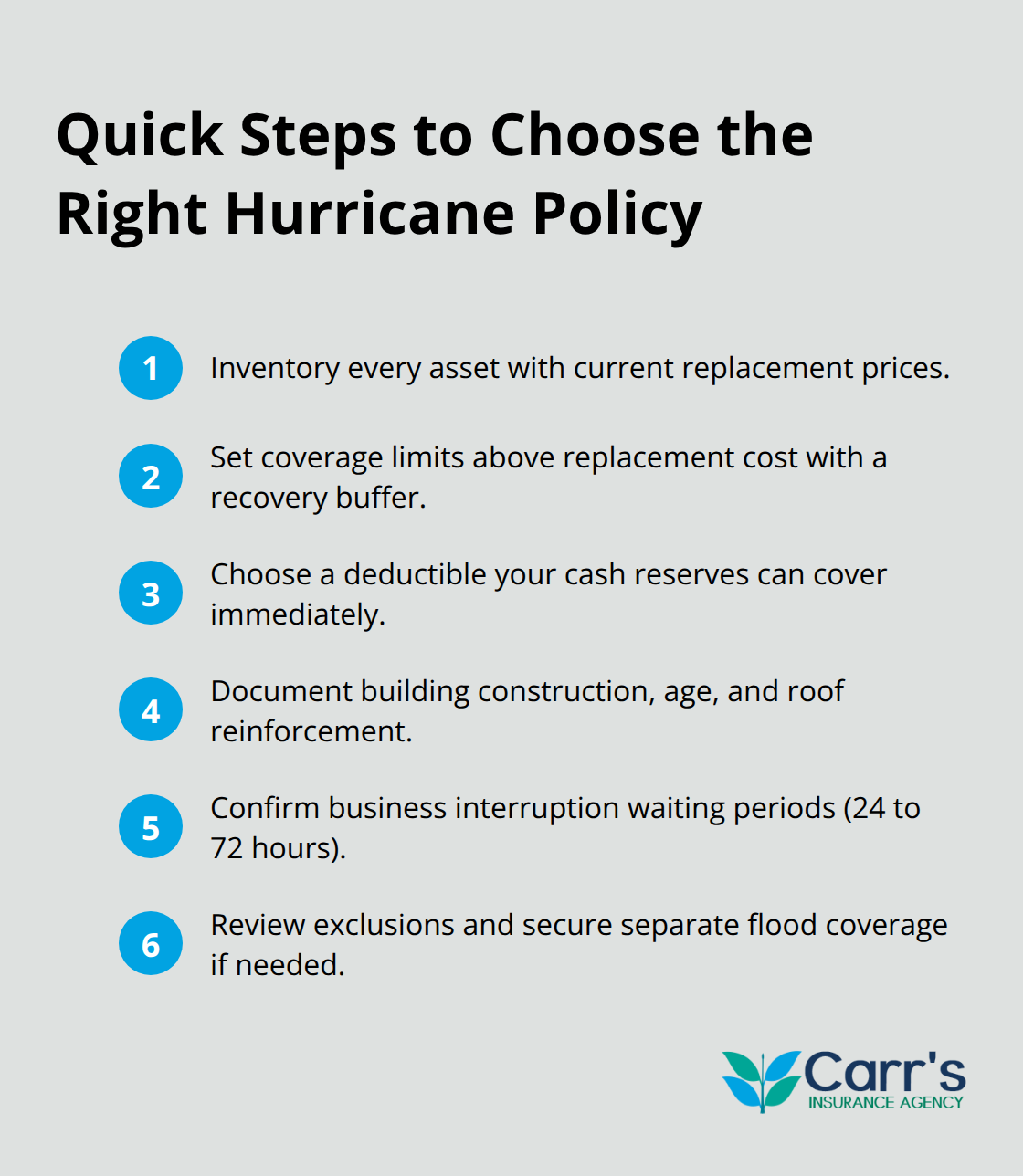
Start with an accurate inventory of what your business actually costs to replace, not what you think it costs. Walk through your facility and document every piece of equipment, inventory, and fixture with current replacement prices from suppliers, not outdated purchase receipts. Many Hawaii business owners underestimate replacement costs because they overlook installation fees, shipping delays from the mainland, and price increases over time. A commercial kitchen with equipment purchased five years ago costs significantly more to replace today than the original purchase price suggests.

Match Coverage Limits to Your Actual Needs

Once you have accurate replacement values, compare those numbers against potential policy limits being offered. Your coverage limit must exceed your replacement cost, not match it, because you’ll face unexpected expenses during recovery that standard replacement costs don’t account for. Deductibles in Hawaii range from $1,000 to $10,000 or higher, and your choice directly affects both your premium and your financial exposure. A $5,000 deductible saves you money on premiums compared to a $1,000 deductible, but you must have $5,000 in cash reserves available immediately after a hurricane hits to cover that out-of-pocket expense before insurance money arrives.

Work with a Local Insurance Agent

A local insurance agent who understands Hawaii’s specific hurricane exposure can review your current policies for gaps and compare hurricane coverage options across multiple carriers rather than locking you into one company’s limitations. During your consultation, bring documentation of your property inventory, financial statements showing annual revenue, and details about your building’s construction and age (since newer concrete structures with reinforced roofs qualify for better rates than older wooden buildings). Ask your agent specifically about waiting periods for business interruption coverage, because that 24 to 72-hour gap means your business absorbs initial losses while you wait for coverage to activate.

Compact checklist of key steps to select the right business hurricane insurance policy in Hawaii.

Understand Policy Exclusions and Flood Coverage

Request a detailed explanation of what your policy excludes, not just what it covers, since exclusions create the real financial surprises after storms. Your agent should explain how flood coverage works separately from wind coverage, since many hurricane policies exclude flood damage entirely and require a separate flood insurance policy through the National Flood Insurance Program or private carriers.

Final Thoughts

Start by scheduling a consultation with an insurance professional who understands Hawaii’s specific hurricane exposure. Bring your business financials, property inventory, and building details so your agent can assess your actual replacement costs and revenue needs. This conversation takes a few hours but prevents months of financial chaos after a hurricane hits.

Document everything your business owns and calculate accurate replacement costs using current supplier pricing, not old purchase receipts. Include installation fees and shipping delays from the mainland, since these costs add up quickly during recovery. Once you have real numbers, match your coverage limits to those costs plus a buffer for unexpected expenses, then select a deductible amount your business can actually pay immediately after a hurricane hits.

We at Carr’s Insurance Agency help Hawaii businesses navigate hurricane exposure and find business hurricane insurance that actually protects their operations. Our locally knowledgeable agents compare rates across top carriers to deliver personalized protection for your specific needs. Contact us to review your current policies and secure the coverage your Hawaii operation requires.

Disclaimer: The information provided in this blog is for general informational purposes only and does not constitute legal, financial, or insurance advice. Coverage options, terms, and availability may vary. Please consult with a licensed professional for advice specific to your situation
Classic Car Insurance Hawaii: Insuring Your Vintage Vehicle

Classic Car Insurance Hawaii: Insuring Your Vintage Vehicle

Your classic car is more than transportation-it’s an investment that deserves protection standard auto policies simply won’t provide. Classic car insurance in Hawaii is specifically designed for vintage vehicles, with coverage options that reflect how collectors actually drive and store their prized possessions.

At Carr’s Insurance Agency, we understand that your collector car needs specialized attention. Let’s walk through what makes classic car coverage different and how to protect your vehicle properly.

Why Standard Car Insurance Fails Classic Vehicles

Standard auto policies treat your vintage car like a daily driver, which means they undervalue it dramatically. These policies calculate payouts using actual cash value, a method that depreciates your classic car based on age and mileage rather than its true market worth. If your 1967 Chevelle suffers damage, a standard insurer might offer you $8,000 when the actual replacement cost reaches $35,000 or higher. Collectors contact us after filing claims on standard policies only to discover their coverage falls thousands of dollars short. The gap exists because standard policies assume cars lose value predictably, but classic cars move in the opposite direction. A well-maintained vintage vehicle appreciates over time, especially rare models. Standard insurers ignore this reality, leaving you massively underprotected.

Agreed Value Coverage Changes Everything

Agreed value coverage works differently. You and your insurer agree on your car’s value upfront, often using market data from sources like CLASSIC.COM, which aggregates pricing from over 2,000 sources including major auction houses like RM Sotheby’s and Mecum. If your 1975 Porsche 911 Carrera receives a valuation of $89,000 and it becomes totaled, you receive $89,000-not some depreciated number pulled from a standard valuation guide. This approach protects your actual investment. The key is setting the valuation correctly initially. You’ll want documentation of your car’s condition, recent appraisals, and market comparables. CLASSIC.COM tracks values for free and sends alerts when similar models sell, helping you stay current with market shifts. This data becomes your insurance foundation. When you work with an independent agent who understands collector vehicles, they’ll help you set a value that reflects your car’s condition and the current market-not arbitrary depreciation tables.

Mileage Limits Reflect Real Collector Habits

Classic car policies include annual mileage restrictions, typically ranging from 2,500 to 7,500 miles per year. This isn’t a limitation-it’s actually protective for you. Collectors don’t drive their vintage vehicles like commuter cars. You take your Mustang to shows, occasional weekend drives, and car club events. That amounts to maybe 3,000 miles annually if you’re active. Standard policies don’t account for this low-mileage reality, charging you for coverage you don’t need. Specialty policies reward your actual driving patterns with lower premiums. You’ll save 30 to 50 percent compared to standard auto insurance because the risk profile is fundamentally different. Your classic car spends most of its time garaged, protected from weather and regular road hazards.

Typical savings for low-mileage classic car insurance compared to standard auto policies.

Setting Your Mileage Expectations Accurately

Report your expected annual mileage honestly when you obtain quotes, and confirm that your policy allows for occasional longer drives to distant car events without penalty. This transparency prevents coverage disputes later and ensures your premium reflects your actual usage. The next step involves understanding what specific coverage options protect your investment beyond basic agreed value protection.

What Coverage Actually Protects Your Classic Car

Agreed value coverage remains the foundation of proper classic car protection, but the real question is how much additional coverage you need beyond that base layer. Your 1969 Camaro might carry $45,000 in agreed value protection, but what happens when you’re restoring it and have $12,000 in NOS parts sitting in your garage waiting for installation? Standard agreed value policies won’t cover those components until they’re permanently attached to the vehicle.

Spare Parts Coverage Protects Your Restoration Investment

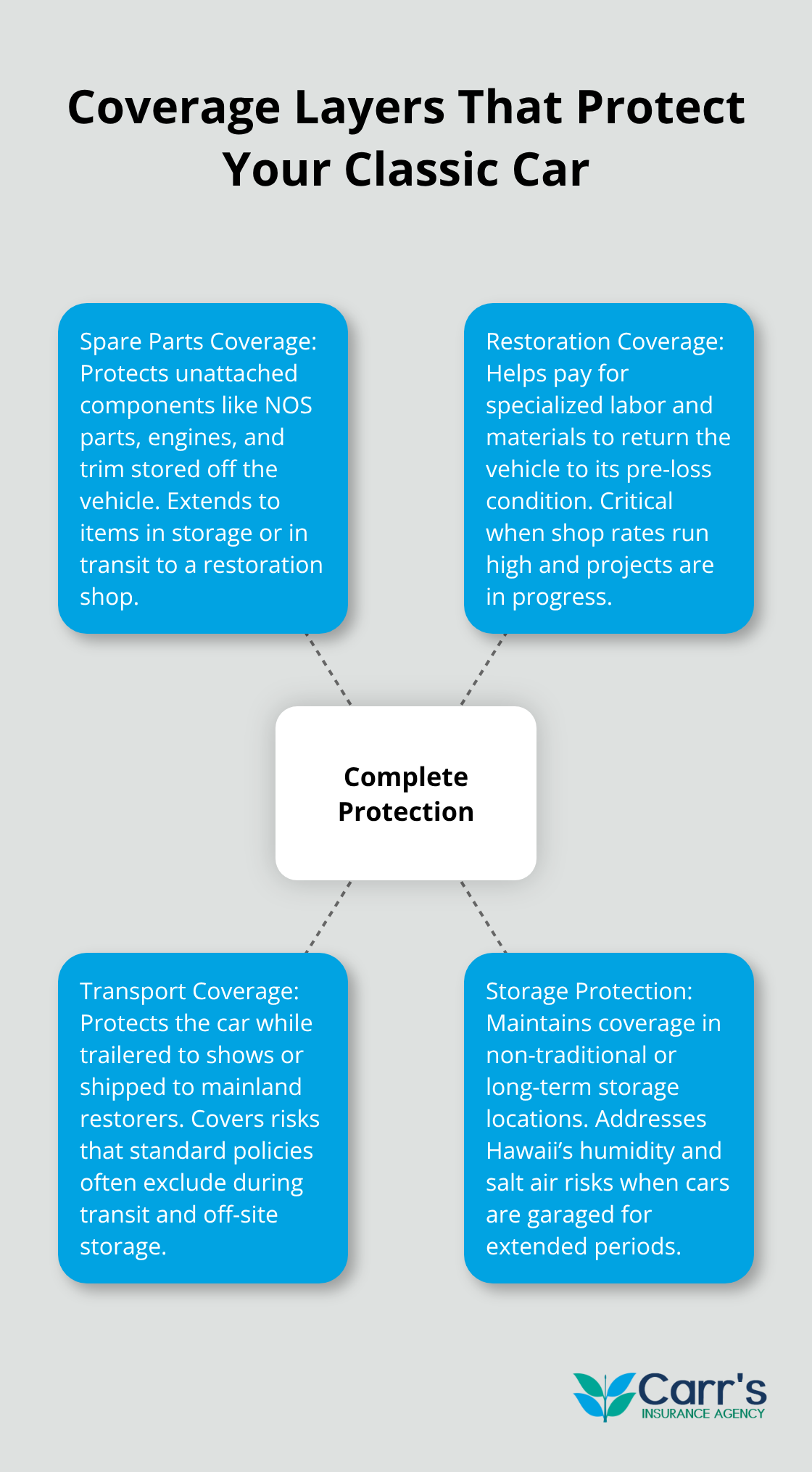
Spare parts coverage fills this gap by protecting your investment in restoration materials, original equipment, and hard-to-find components stored off the vehicle. This coverage typically costs just 10 to 15 percent more than base agreed value but prevents catastrophic losses when fire, theft, or weather damage strikes your collection. The coverage extends to parts in storage, parts being transported to a restoration shop, and components waiting for installation.

Without this rider, a garage fire that destroys your original 427 big-block engine and transmission results in zero payout on a standard agreed value policy. Restoration coverage works alongside parts protection by covering the labor costs and materials involved in bringing your vehicle back to its pre-loss condition. High-end restorations demand significant labor investment (specialist shops charge $150 to $300 per hour), making this protection essential for serious collectors.

Transportation Coverage Protects Your Vehicle in Transit

Your classic car faces different risks than daily drivers, particularly when being transported to shows, auctions, or restoration facilities. Standard auto policies exclude coverage during transport on trailers or while stored in non-residential locations-precisely when many collectors need protection most. Transport coverage specifically protects your vehicle while it travels on a trailer to a car show or ships to a specialist restorer on the mainland.

Hub-and-spoke view of key coverage types for classic cars: spare parts, restoration, transport, and storage. - Classic car insurance Hawaii

This protection matters because the trailer journey introduces exposure that your garage doesn’t. Weather, road hazards, and accidents during transport can total a classic car before it ever reaches its destination. Transport coverage activates the moment your vehicle leaves your property and continues until it arrives at its final location.

Storage Protection Addresses Hawaii’s Unique Climate Challenges

Storage protection extends coverage to vehicles kept in non-traditional storage-climate-controlled storage units, private warehouses, or even at a friend’s property-maintaining full protection regardless of where your car sits between driving seasons. Hawaii’s salt air and humidity create additional storage concerns that mainland collectors rarely face; your classic car stored in a standard garage without climate control can suffer significant corrosion damage over a six-month period.

Agreed value policies often restrict coverage for vehicles stored longer than 30 days or parked at non-residential addresses without explicit storage coverage added to your policy. This limitation leaves your investment vulnerable during the off-season months when many collectors store their vehicles. Adding storage protection removes these restrictions and ensures your car remains fully covered no matter how long it sits or where you keep it.

Understanding these coverage layers helps you build a complete protection strategy. The next step involves determining your vehicle’s actual value-a process that requires accurate documentation and market research.

Getting Your Classic Car Properly Valued and Insured

Establish Your Vehicle’s True Market Value

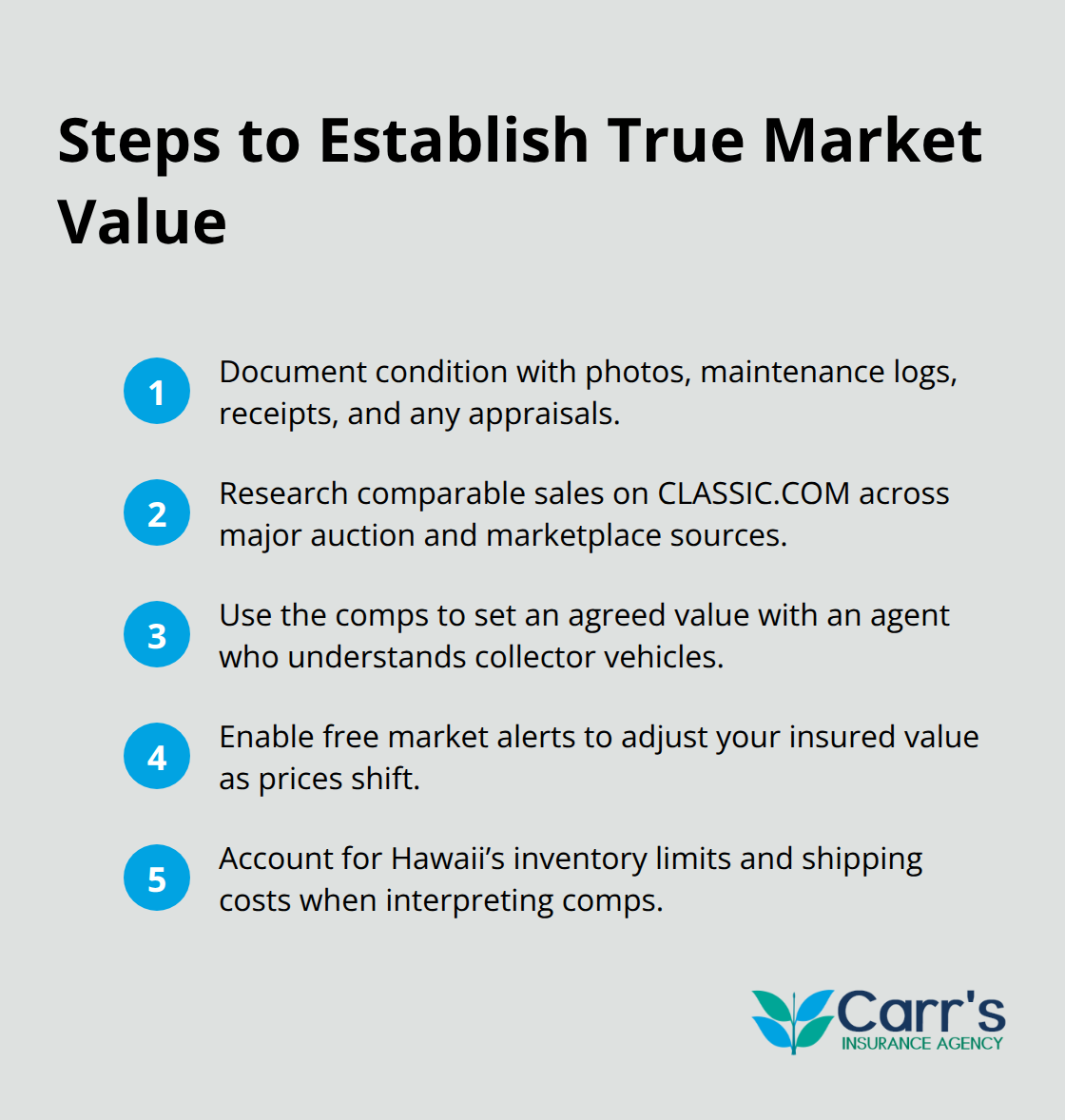
Valuing your classic car accurately forms the foundation of everything that follows. You cannot obtain proper agreed value coverage without knowing what your vehicle is actually worth, and this number differs dramatically from what you might guess. Start by gathering documentation of your car’s condition-photographs from multiple angles, maintenance records, restoration receipts, and any professional appraisals you’ve had completed. Next, research comparable sales using CLASSIC.COM, which aggregates data from over 2,000 sources including RM Sotheby’s, Mecum, Bring a Trailer, and Hagerty Marketplace Auctions. If your 1972 Datsun 240Z appears in fair condition, CLASSIC.COM might show similar models selling between $28,000 and $35,000 depending on originality and mileage.

Key steps to document and research your classic car’s market value before setting agreed value. - Classic car insurance Hawaii

Use this market data as your valuation anchor.

The platform offers free market-tracking alerts that notify you when comparable vehicles sell, helping you adjust your insurance value as market conditions shift throughout the year. Hawaii’s collector car market moves differently than mainland markets due to limited inventory and shipping costs, so tracking actual sales data specific to your vehicle type matters more than general depreciation guides.

Choose an Agent Who Specializes in Collector Vehicles

Once you’ve established your car’s value, the agent you choose becomes critical to your protection strategy. An independent agent who specializes in collector vehicles understands the nuances that standard auto agents miss-they know that a 1967 Chevelle with matching numbers commands premium pricing, that restoration-in-progress vehicles need different coverage than finished cars, and that Hawaii’s salt air demands enhanced storage protection. An independent agent can compare rates across multiple carriers rather than pushing you toward a single company’s limited options.

When you meet with your agent, bring your CLASSIC.COM valuation data, your documentation photos, and your maintenance records. Discuss whether you need spare parts coverage for components in storage, transportation protection for upcoming shows or shipments, and storage coverage that accounts for Hawaii’s climate demands. The agent should ask detailed questions about your driving habits, planned mileage, storage conditions, and any restoration work in progress. If an agent doesn’t ask these questions, they’re not giving your classic car the attention it deserves.

Leverage Bundling to Reduce Your Overall Costs

Explore bundling opportunities by combining your classic car policy with homeowners insurance, other vehicles, or boat coverage if you own multiple assets. Bundling typically reduces your overall premium by 10 to 25 percent across all policies, making comprehensive coverage more affordable than insuring your classic car alone. This approach protects your entire collection under one relationship with an agent who understands your specific needs.

Final Thoughts

Your classic car represents years of passion, investment, and careful stewardship. Protecting it with proper classic car insurance in Hawaii means selecting coverage that reflects what your vehicle is actually worth and how you truly drive it. Standard auto policies fail collectors because they ignore that vintage vehicles appreciate rather than depreciate, that mileage stays low, and that restoration components and specialized storage matter.

We at Carr’s Insurance Agency have specialized in collector vehicle coverage since 1990 as a locally owned, independent agency serving Hawaii. Our licensed agents understand the specific challenges classic car owners face in Hawaii’s climate and market conditions, and we represent top carriers to compare rates across multiple options rather than limiting you to a single company’s offerings. When you work with us, you receive personalized service from people who actually understand what makes your 1967 Chevelle or 1975 Porsche 911 different from a daily driver.

The process starts with accurate valuation using market data, continues through selecting an agent who asks the right questions about your storage conditions and driving plans, and concludes with bundling opportunities that reduce your overall costs. Contact Carr’s Insurance Agency today to discuss your classic car’s specific coverage needs and discover how much you can save with proper collector vehicle insurance.

Disclaimer: The information provided in this blog is for general informational purposes only and does not constitute legal, financial, or insurance advice. Coverage options, terms, and availability may vary. Please consult with a licensed professional for advice specific to your situation
Fleet Auto Insurance Hawaii: Manage a Growing Fleet

Fleet Auto Insurance Hawaii: Manage a Growing Fleet

Running a growing fleet in Hawaii comes with rising insurance costs that can quickly strain your budget. At Carr’s Insurance Agency, we help fleet owners navigate fleet auto insurance in Hawaii and find real ways to cut premiums without cutting corners.

This guide walks you through how fleet size affects your rates, what coverage options actually matter, and proven strategies to reduce your insurance costs.

How Your Fleet Size Drives Insurance Costs

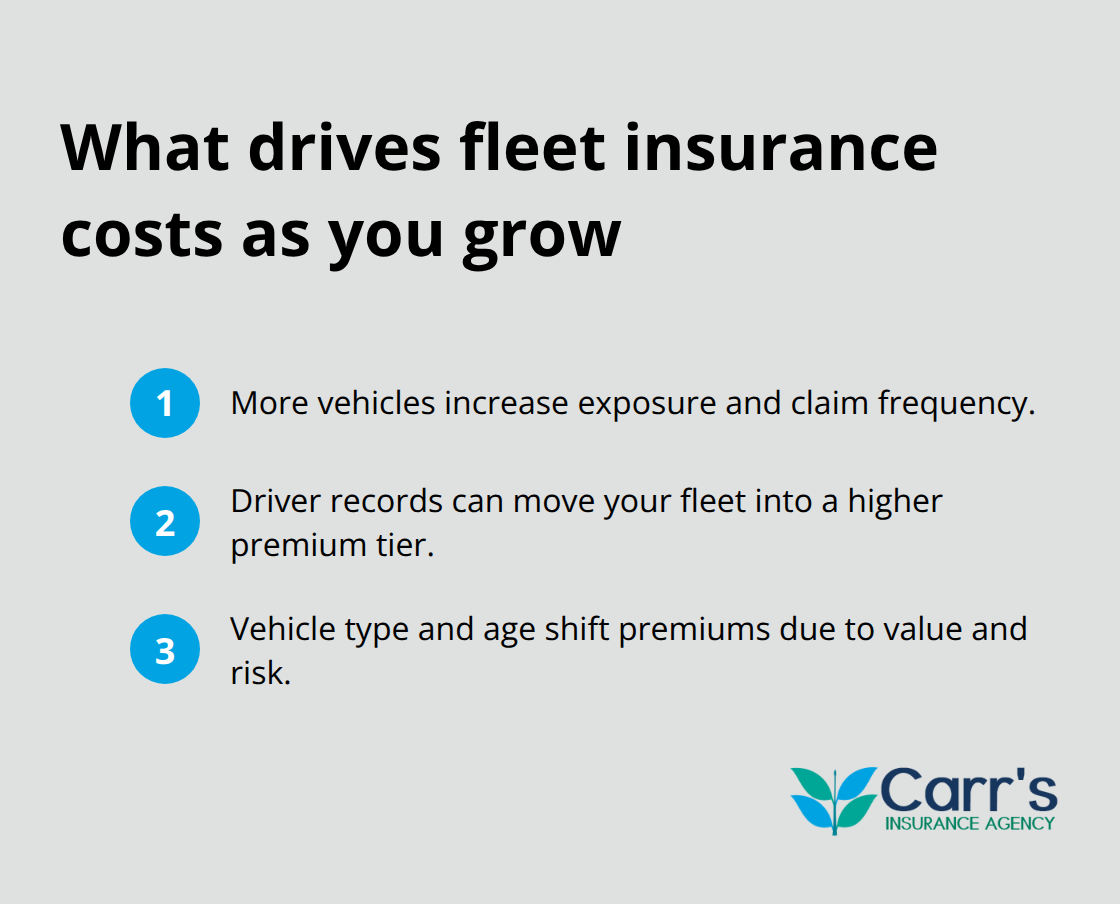
Every vehicle you add to your fleet in Hawaii increases your insurance premiums, but the relationship between fleet size and cost isn’t linear. A fleet that grows from five to ten vehicles typically sees rate increases of 15 to 25 percent, while expanding from ten to twenty vehicles can push costs up another 20 to 30 percent. Insurance carriers view larger fleets as statistically riskier because more vehicles create greater exposure to accidents, theft, and liability claims. The specific rate structure depends heavily on your drivers’ records and the types of vehicles you operate, but size alone moves the needle significantly.

Key factors that raise fleet insurance premiums as your fleet expands

Driver Records Shape Your Premium Tier

Your drivers’ history determines whether you pay standard rates or premium rates for your entire fleet. A single driver with multiple at-fault accidents or traffic violations can increase your fleet’s premium by 10 to 40 percent across all vehicles, since insurers apply that risk profile to your overall operation. Hawaii has a 6.2 traffic fatality rate per 100,000 residents, making safe driving records especially valuable in our state. When you shop for quotes, emphasize drivers with clean records because carriers reward low-accident fleets with better rates. One driver with a poor history drags down your entire operation’s rating, making driver screening and training non-negotiable investments for growing fleets.

Vehicle Type and Age Directly Impact Your Bills

Newer commercial vehicles cost more to insure than older models because replacement value is higher, but they also qualify for safety discounts that older vehicles don’t. A 2024 commercial pickup truck typically costs 20 to 35 percent more to insure than a 2018 model of the same make, though the newer truck’s advanced safety features can offset some of that difference through discounts. Heavy-duty vehicles like box trucks or flatbeds carry premiums 40 to 60 percent higher than standard vans because they’re involved in more complex claims. When you add vehicles to your fleet, mix vehicle ages strategically-maintaining a balanced fleet of newer and mid-age vehicles often costs less than converting entirely to new equipment.

How Coverage Needs Shift With Fleet Growth

As your fleet expands, your coverage requirements become more complex and demand closer attention. Larger fleets face higher liability exposure, which means you need adequate commercial auto liability limits to protect your business from catastrophic claims. Physical damage coverage becomes increasingly important when you operate multiple vehicles across Hawaii’s varied terrain and traffic conditions. The coverage options you select directly influence your total premium, making it essential to understand what each option protects before your fleet reaches the next growth stage.

Coverage Options for Hawaii Fleet Owners

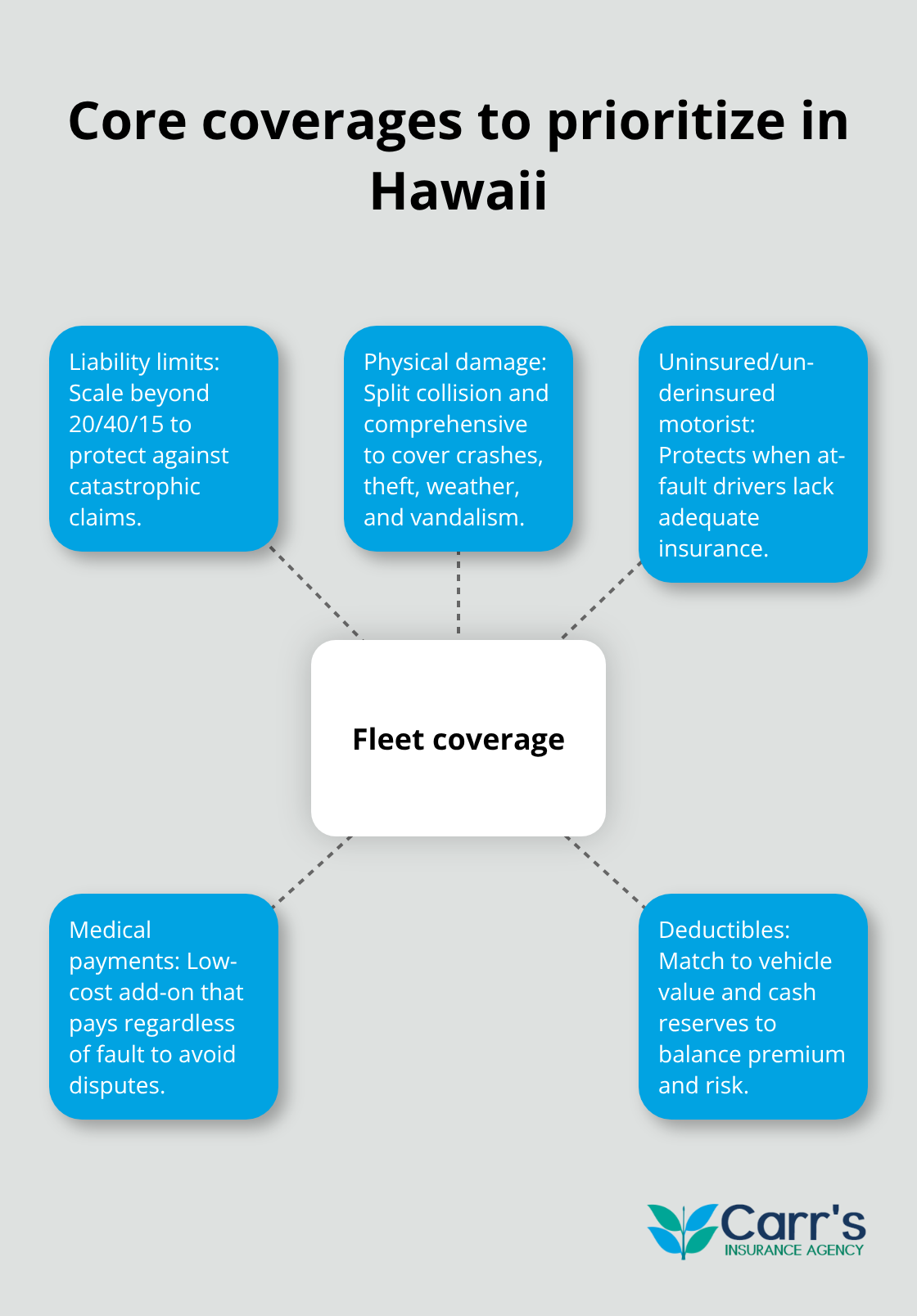
Commercial auto liability is non-negotiable for any fleet operating in Hawaii, and the minimum state requirement of 20/40/15 (twenty thousand bodily injury per person, forty thousand per accident, fifteen thousand property damage) falls short for growing operations. Most carriers recommend 100/300/100 limits for fleets with more than five vehicles, and you should avoid settling for state minimums because a single serious accident can generate medical bills exceeding two hundred thousand dollars. Hawaii’s average auto accident injury claim costs roughly thirty-eight thousand dollars according to the National Safety Council, meaning your liability exposure grows exponentially as your fleet expands.

Liability Limits Scale With Fleet Risk

Your liability limits should reflect your actual exposure, not just state minimums or industry averages. A fleet that hauls materials or operates in high-traffic areas needs higher limits than a fleet making local deliveries, and catastrophic injury claims routinely exceed three hundred thousand dollars in Hawaii’s litigious environment. Medical payments coverage adds five to ten dollars per vehicle monthly but covers medical expenses regardless of fault, making it practical protection that prevents smaller accidents from becoming insurance disputes.

Physical Damage Coverage Protects Your Assets

Physical damage coverage splits into collision and comprehensive protection, with collision covering accidents you cause and comprehensive handling theft, weather, and vandalism. For growing fleets in Hawaii, comprehensive coverage matters more than many fleet owners realize because our islands experience higher rates of vehicle theft than the mainland average, with over fifteen thousand vehicles stolen annually across Hawaii. Resist the temptation to minimize physical damage limits on older vehicles because replacement costs in Hawaii run twenty to thirty percent higher than mainland prices due to shipping and local market conditions.

Hub-and-spoke showing the essential fleet insurance coverages for Hawaii operations - Fleet auto insurance Hawaii

Uninsured Motorist Protection Fills Critical Gaps

Uninsured and underinsured motorist protection fills a critical gap when other drivers lack adequate insurance or flee the scene, and this coverage applies to your entire fleet uniformly. 15.4 percent of motorists in 2023 were uninsured, according to the Insurance Research Council, making this protection genuinely valuable rather than theoretical. This coverage protects your operation when you encounter drivers who cannot pay for damages they cause.

Deductible Strategy Impacts Your Bottom Line

Higher deductibles lower your premiums but require cash reserves to cover claims, so growing fleets should match deductible amounts to their financial capacity and accident history rather than defaulting to five-hundred-dollar amounts. A five-hundred-dollar deductible on a twenty-thousand-dollar van creates unnecessary exposure compared to a one-thousand-dollar deductible on a forty-thousand-dollar box truck. Tailoring your deductibles based on each vehicle’s replacement value and your fleet’s accident history produces better financial outcomes than applying uniform deductibles across all vehicles.

As your fleet grows, the coverage decisions you make today directly affect your ability to manage risk and control costs tomorrow.

Managing Risk and Reducing Fleet Insurance Premiums

Driver Safety Training Cuts Accident Rates Fast

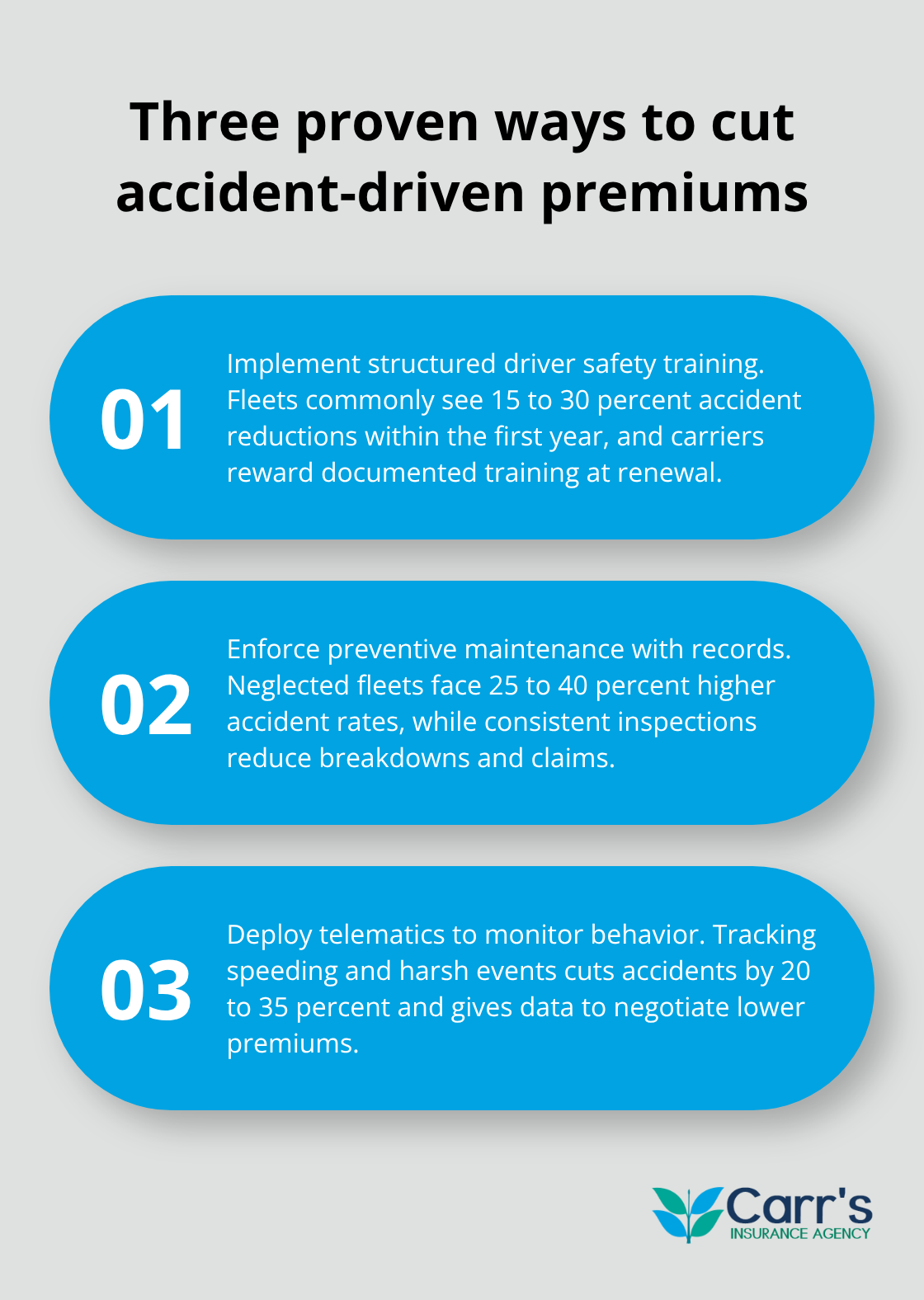
Driver safety training programs reduce accident rates faster than any other single intervention, and the financial returns justify the investment immediately. Fleets that implement structured safety programs see accident reductions of 15 to 30 percent within the first year, according to the National Safety Council, which means fewer claims translate directly into lower premiums at renewal. Programs like the National Safety Council’s Defensive Driving Course or Fleet Safety International’s training modules cost between fifty and two hundred dollars per driver annually, but a single serious accident claim in Hawaii averages thirty-eight thousand dollars, making the math straightforward. Insurance carriers actively reward fleets that document completed safety training with rate reductions, so maintain certificates and share completion records when you renew your policy. Trained drivers cause fewer accidents, which means less vehicle downtime and lower repair costs across your fleet.

Maintenance Inspections Prevent Expensive Claims

Fleets with vehicles that fail basic maintenance inspections experience accident rates 25 to 40 percent higher than well-maintained operations, which means skipping routine maintenance directly increases your insurance costs. Track tire tread depth, brake condition, and fluid levels monthly because worn tires and failed brakes cause preventable accidents that spike your premiums at renewal. Worn components create liability exposure that extends beyond simple repair bills-they increase your risk profile in the eyes of insurance carriers. Establish a maintenance schedule that your team follows consistently, and document all inspections to demonstrate your commitment to vehicle safety.

Telematics Systems Monitor Driver Behavior

Modern telematics systems like Samsara or Verizon Connect cost thirty to seventy dollars per vehicle monthly but provide real-time data on harsh braking, speeding, and unsafe turns that correlate strongly with accident frequency. Fleets that monitor driver behavior through telematics see accident reductions of 20 to 35 percent because drivers modify behavior when they know their actions are tracked. Reward safe drivers with bonuses or recognition programs, and address poor driving patterns immediately through retraining or reassignment because one aggressive driver can damage your entire fleet’s rating.

Three-step overview of training, maintenance, and telematics strategies that reduce fleet accidents and premiums - Fleet auto insurance Hawaii

The data these systems collect also supports your case when you request premium reductions from your carrier at renewal time.

Final Thoughts

Managing fleet auto insurance in Hawaii requires you to balance growth with smart risk management, and the strategies outlined here directly reduce your premiums while protecting your operation. Driver safety training, vehicle maintenance, and telematics monitoring work together to lower accident rates and demonstrate to insurers that your fleet operates responsibly. A fleet that implements safety training sees accident reductions of 15 to 30 percent within the first year, while proper maintenance prevents the 25 to 40 percent higher accident rates that plague neglected operations.

These improvements translate into lower premiums at renewal and reduced downtime from preventable accidents. Your growing fleet’s success depends on treating fleet auto insurance Hawaii as an operational expense you can actively control rather than a fixed cost you simply accept. Clean driving records, appropriate coverage limits, and strategic deductible placement ensure you’re not overpaying for protection you don’t need while maintaining adequate coverage for claims that matter.

Contact Carr’s Insurance Agency to review your current fleet auto insurance coverage and explore rate reductions based on your safety initiatives. Bring your driver records, vehicle list, and any safety training documentation you’ve completed, and we’ll identify specific opportunities to lower your costs without compromising protection. We at Carr’s Insurance Agency represent top carriers and compare rates to find coverage that matches your actual needs and budget.

Disclaimer: The information provided in this blog is for general informational purposes only and does not constitute legal, financial, or insurance advice. Coverage options, terms, and availability may vary. Please consult with a licensed professional for advice specific to your situation
Hawaii Business Auto Insurance Essentials

Hawaii Business Auto Insurance Essentials

Running a business in Hawaii means protecting your vehicles from real risks. Your company’s fleet faces unique challenges, from coastal weather to heavy traffic on island roads.

We at Carr’s Insurance Agency know that Hawaii business auto insurance isn’t one-size-fits-all. This guide walks you through what coverage actually matters, mistakes to avoid, and how to pick the right policy for your operation.

What Your Hawaii Business Auto Insurance Actually Covers

Liability Coverage: Your First Line of Defense

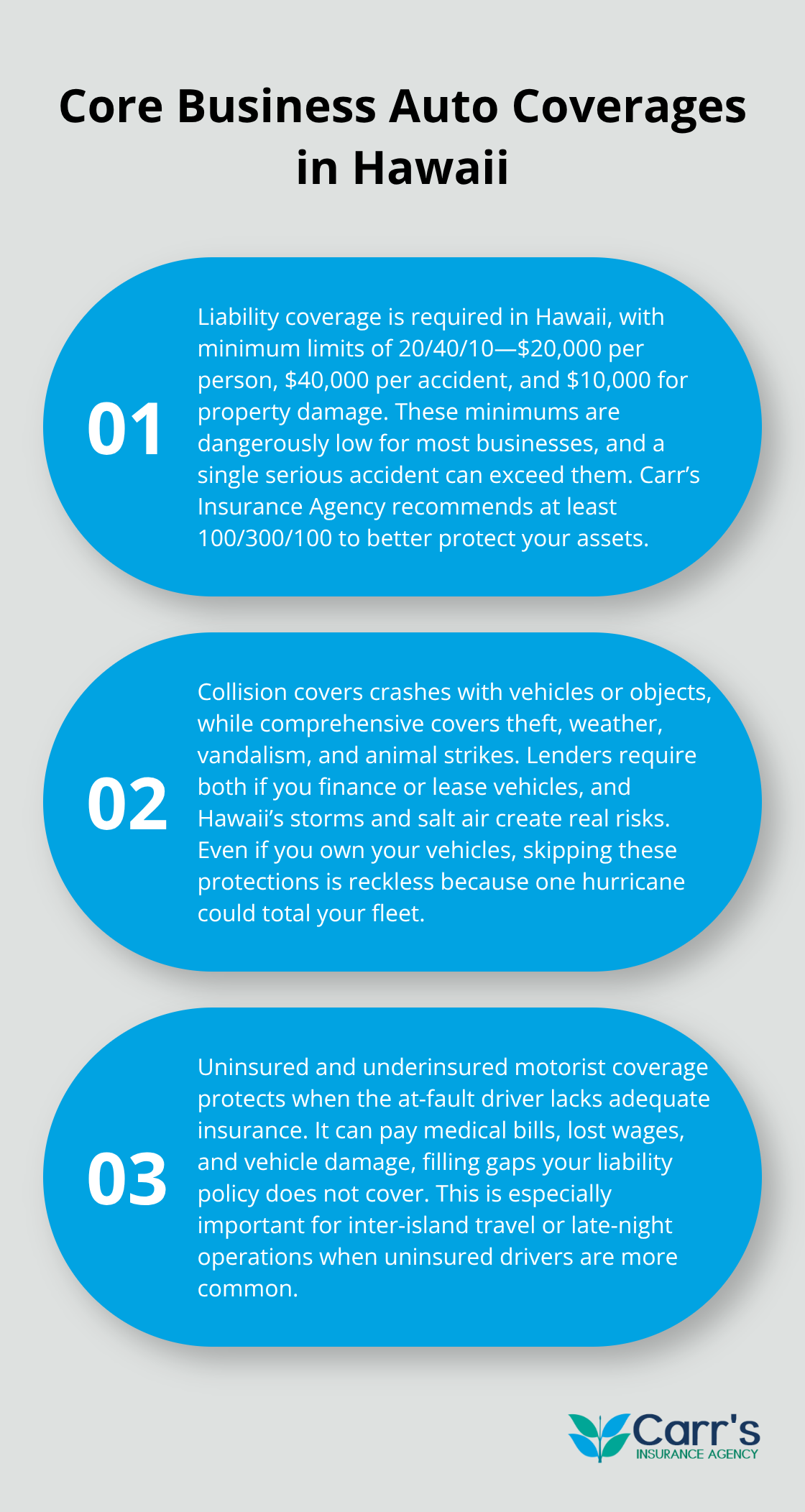
Liability coverage protects your business when your vehicle damages someone else’s property or injures another person. Hawaii requires minimum liability limits of 20/40/10, meaning $20,000 for bodily injury per person, $40,000 per accident, and $10,000 for property damage. These minimums are dangerously low for most businesses. If your delivery van hits a parked car worth $35,000, you face personal liability for the $25,000 difference. A single accident involving injuries could bankrupt a small operation. We at Carr’s Insurance Agency recommend Hawaii business owners carry at least 100/300/100 limits, which protects your assets far better and costs only slightly more than state minimums.

Collision and Comprehensive: Protecting Your Fleet

Collision and comprehensive coverage handles damage to your own vehicles. Collision pays for accidents with other vehicles or objects, while comprehensive covers theft, weather, vandalism, and animal strikes. Hawaii’s tropical storms and salt air create real risks. If you finance or lease vehicles, lenders require both coverages. Even if you own vehicles outright, skipping these protections is reckless. One hurricane could total your entire fleet.

Uninsured and Underinsured Motorist Coverage: Closing the Gap

Uninsured and underinsured motorist coverage protects your drivers when they’re hit by someone without adequate insurance. This coverage pays your medical bills, lost wages, and vehicle damage when the other driver can’t. Many Hawaii business owners assume their liability policy covers this-it doesn’t. Your drivers need this protection, especially those traveling between islands or working late nights when uninsured drivers are more common.

Overview of liability, collision/comprehensive, and uninsured/underinsured motorist coverage for Hawaii business vehicles - Hawaii business auto insurance

Understanding what your policy covers is only half the battle. Most Hawaii business owners make critical mistakes that leave their operations exposed to unnecessary risk.

Common Mistakes Hawaii Business Owners Make with Auto Insurance

Underestimating Coverage Limits

Most Hawaii business owners set their coverage limits based on what sounds reasonable rather than what actually protects their assets. A delivery company with five vehicles and $500,000 in annual revenue carrying only state-minimum liability coverage faces catastrophic exposure. One accident where your driver injures someone seriously could result in a judgment far exceeding your policy limit, leaving your business responsible for the difference. Most business owners discover this gap only after a claim happens.

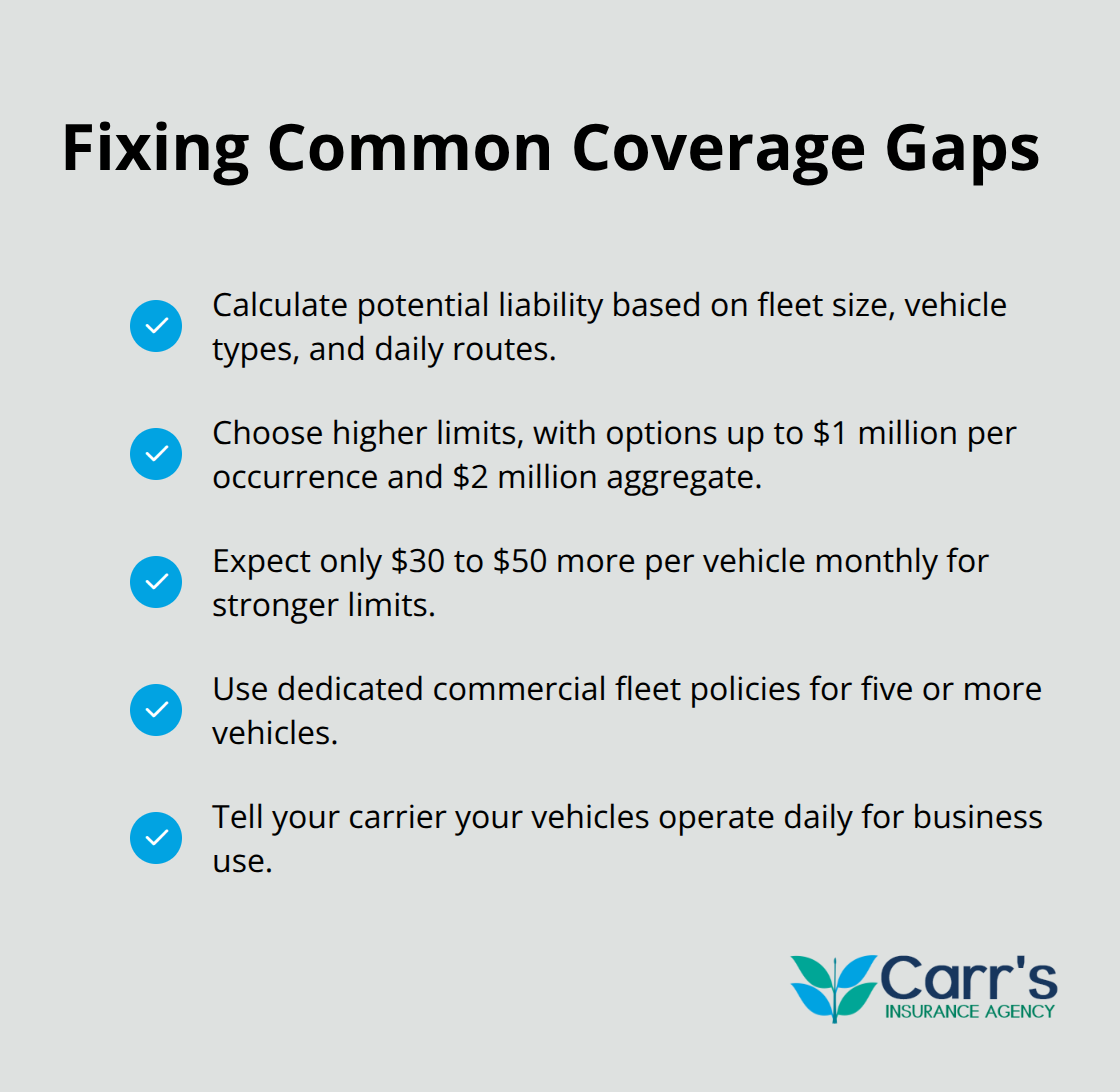
The fix is straightforward: calculate your potential liability exposure by considering your fleet size, vehicle types, and daily routes. A contractor operating heavy equipment near residential areas faces different risks than a service business making local deliveries. Policies typically offer coverage limits up to $1 million per occurrence and $2 million aggregate. The premium difference between standard limits and higher limits typically runs only $30 to $50 monthly per vehicle-a small price for real protection.

Actionable steps Hawaii business owners can take to close common auto insurance gaps

Ignoring Fleet-Specific Policies

Many business owners purchase standard personal auto insurance for company vehicles, which either won’t cover business use or leaves gaps in coverage. Commercial policies account for higher mileage, multiple drivers, and business-related accidents that personal policies exclude. If your driver causes an accident while making a business delivery and you’re carrying personal insurance, your claim gets denied, and you pay out of pocket.

Hawaii businesses with five or more vehicles need dedicated commercial fleet policies, not individual personal policies stacked together. Personal policies simply weren’t designed for the demands of business operations. Your commercial carrier needs to know that your vehicles operate daily for business purposes, not just occasional personal use.

Failing to Update Coverage After Business Changes

Coverage changes need to happen when your business changes. If you added three new service vehicles last year and didn’t update your policy, your fleet size on paper doesn’t match reality. If you transitioned from local deliveries to inter-island transport, your coverage requirements shifted because your drivers face different road conditions and longer exposure times.

Business changes like hiring more drivers, expanding service areas, or adding specialized equipment trigger policy reviews that most owners skip. The result is outdated coverage that doesn’t match current operations, leaving you underprotected exactly when you think you’re fully covered. Your policy should reflect what your business actually does today, not what it did last year.

Selecting the right business auto insurance requires more than just comparing prices-it demands understanding your specific operational needs and matching them to appropriate coverage.

How to Choose the Right Business Auto Insurance for Your Hawaii Company

Assess Your Fleet Size and Vehicle Types

Start by calculating what your business actually needs rather than guessing. Most Hawaii business owners underestimate their exposure because they think about best-case scenarios instead of worst-case ones. A single accident where your driver injures multiple people or damages expensive property can exceed $500,000 in liability claims within minutes.

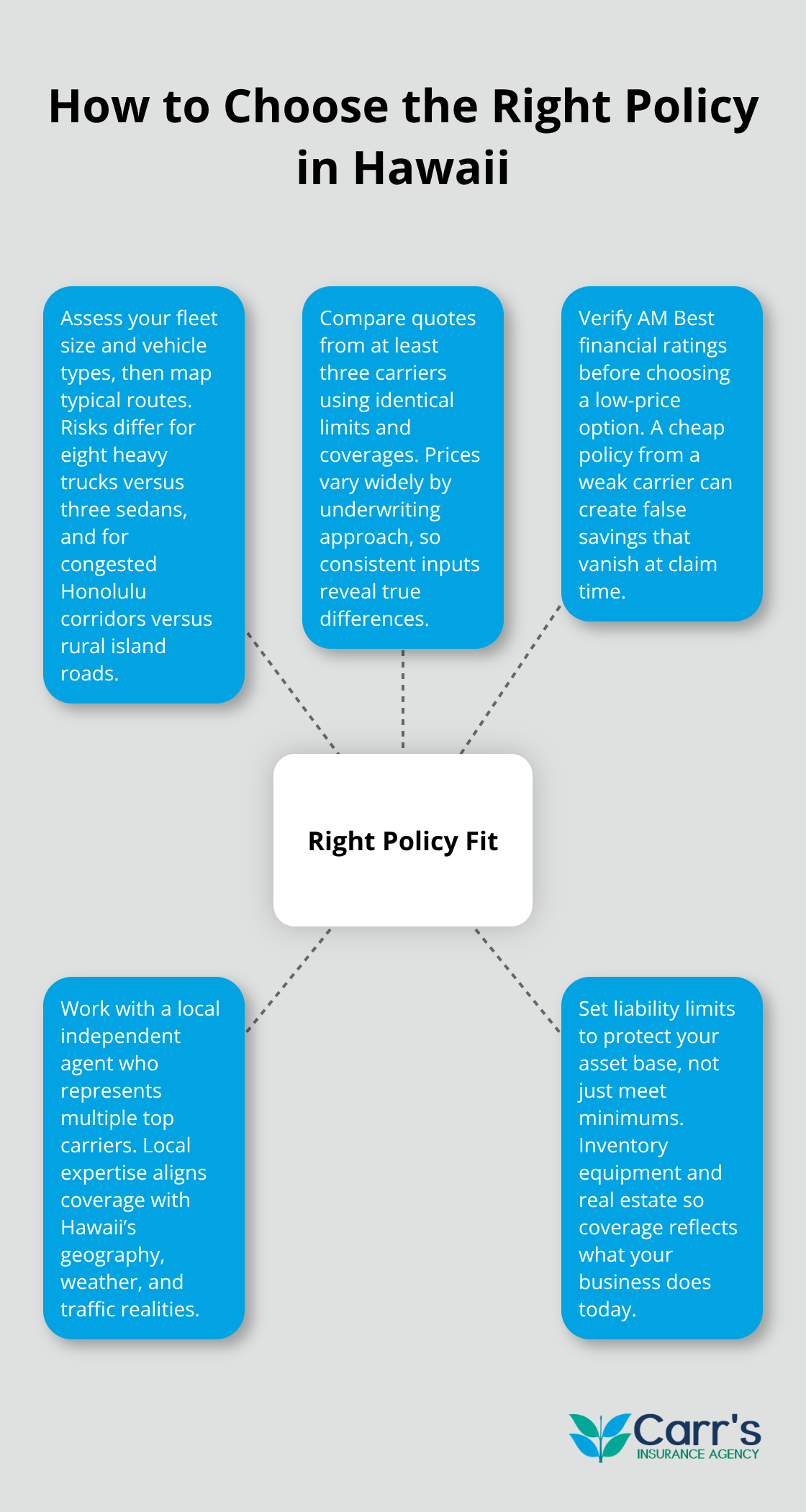
Your fleet size determines your total exposure across all vehicles. A contractor running eight heavy trucks faces far different risk than a service company with three sedans. Document your current fleet, including vehicle types, weights, and how many drivers operate them. Then identify where your vehicles travel most frequently. Routes through congested Honolulu neighborhoods carry different risks than rural island roads.

Next, calculate your business assets that could be at risk if a major claim occurs. If your business has $1.2 million in equipment and real estate, your insurance limits should protect that asset base, not just cover the minimum legal requirement.

Compare Quotes from Multiple Carriers

Try quotes from at least three different carriers because rates for Hawaii commercial auto insurance vary dramatically based on underwriting approach. One carrier might charge $180 monthly per vehicle while another quotes $240 for identical coverage, and a third quotes $165. These differences matter significantly across a five-vehicle fleet.

Hub-and-spoke guide to selecting the right Hawaii commercial auto insurance - Hawaii business auto insurance

Request quotes for the same coverage limits across all carriers so you can make accurate comparisons. Most carriers offer online quote tools, but Hawaii-specific commercial policies often require talking directly with an agent because of our unique operational environment. When comparing quotes, look beyond price at the carrier’s financial ratings through AM Best, which measures whether an insurance company can actually pay claims. An extremely cheap quote from a carrier with a low financial rating creates false savings that disappear when you file a claim and discover the company can’t pay it.

Work with a Local Agent Who Understands Hawaii Requirements

A local agent who knows Hawaii’s specific insurance landscape saves you money and protects your business better than online quote tools alone. Local agents understand how island geography, weather patterns, and traffic conditions affect your rates and coverage needs. They also know which carriers perform best for Hawaii operations and which ones create problems during claims.

An independent agent representing multiple top carriers shows you side-by-side quotes and explains why premiums differ rather than just offering you one company’s option. This approach takes more time upfront but delivers better results because you see real alternatives instead of accepting whatever one carrier offers. We at Carr’s Insurance Agency, a locally owned independent agency serving Hawaii since 1990, represent top carriers and provide licensed, locally knowledgeable agents who compare rates to help you find the right coverage at the best price.

Final Thoughts

Hawaii business auto insurance protects your operation from financial disaster, but only when your coverage matches your actual business needs. The mistakes we covered-underestimating limits, ignoring fleet policies, and skipping coverage updates-cost business owners thousands in unexpected expenses every year. Your liability exposure, fleet size, and operational area determine what protection you genuinely need, not what sounds adequate.

A local Hawaii insurance agency gives you advantages that online quote tools simply cannot match. A local agent understands how island geography, weather patterns, and traffic conditions affect your rates and coverage requirements, and they know which carriers perform reliably when Hawaii businesses file claims. An independent agent representing multiple top carriers shows you real alternatives instead of locking you into one company’s limited options.

Contact Carr’s Insurance Agency to discuss your specific needs with an agent who knows Hawaii’s insurance landscape. A brief conversation now prevents expensive surprises later when accidents happen and you discover your coverage falls short.

Disclaimer: The information provided in this blog is for general informational purposes only and does not constitute legal, financial, or insurance advice. Coverage options, terms, and availability may vary. Please consult with a licensed professional for advice specific to your situation
Hawaii Vehicle Liability Insurance: Know Your Liability

Hawaii Vehicle Liability Insurance: Know Your Liability

Hawaii vehicle liability insurance isn’t optional-it’s the law. Every driver on the islands must carry minimum coverage, and understanding what that means for your wallet and your protection matters.

At Carr’s Insurance Agency, we’ve helped countless Hawaii drivers navigate these requirements and find the right limits for their situation. The difference between minimum coverage and adequate protection can be substantial when an accident happens.

Hawaii’s Vehicle Liability Insurance Requirements

Minimum Coverage Limits Set by State Law

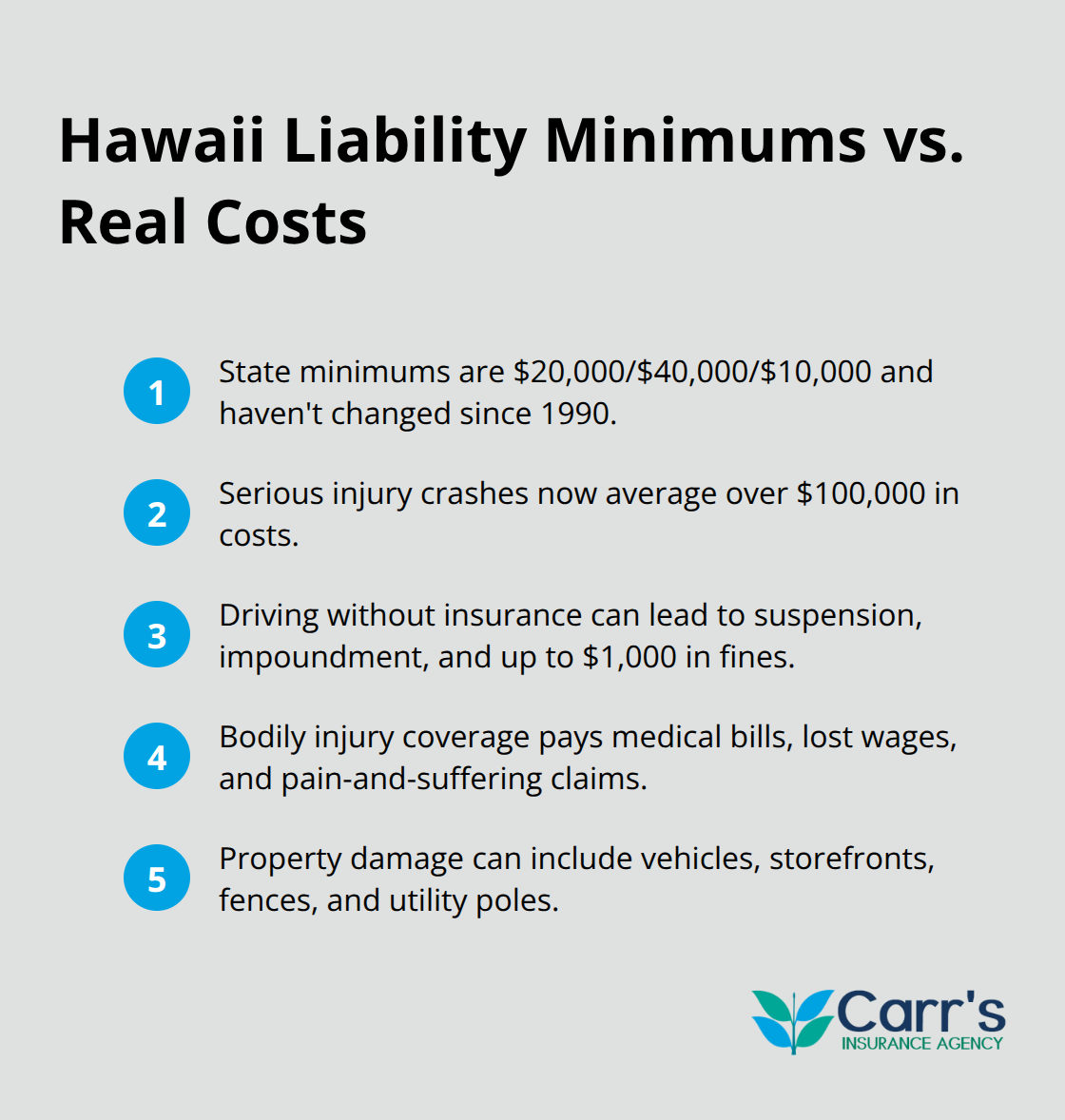
Hawaii law mandates that every driver carry minimum liability coverage of $20,000 for bodily injury per person, $40,000 for bodily injury per accident, and $10,000 for property damage. These minimums have remained unchanged since 1990, which means they haven’t kept pace with inflation or the rising cost of medical care. According to the National Safety Council, the average cost of a serious crash involving injuries now exceeds $100,000, making Hawaii’s minimums dangerously inadequate for most drivers.

If you cause an accident that injures someone or damages property beyond these limits, you become personally liable for the excess amount. Creditors can pursue your wages, bank accounts, and assets to cover the difference. The state doesn’t allow you to skip this coverage either; driving without liability insurance results in license suspension, vehicle impoundment, and fines up to $1,000 for a first offense.

Key facts about Hawaii auto liability minimums, real-world costs, and penalties - Hawaii vehicle liability insurance

Bodily Injury Coverage Protects Medical Bills

Bodily injury liability covers medical expenses, lost wages, and pain-and-suffering claims when you injure someone in an accident. A single hospitalization in Hawaii can easily cost $50,000 to $100,000, which exceeds the state minimum by several times over. If you’re found at fault for an accident where someone requires surgery or long-term care, the injured party’s attorney will pursue the maximum available under your policy.

Most drivers underestimate how quickly claims accumulate when multiple people are injured or when injuries require ongoing treatment. Try carrying at least $100,000 in bodily injury coverage per person, as this better reflects actual medical costs in Hawaii.

Property Damage Liability Covers More Than You Think

Property damage liability covers repairs to other vehicles, fences, utility poles, and storefronts. Hawaii’s minimum of $10,000 sounds reasonable until you hit a luxury vehicle on Kalakaua Avenue or damage a storefront. A single accident involving a high-end car or commercial property can quickly exceed this limit, leaving you responsible for thousands out of pocket.

Understanding these coverage gaps matters because your personal assets remain at risk when accidents exceed your policy limits. The next section examines real-world scenarios where liability coverage makes the difference between financial stability and serious hardship.

Real-World Scenarios Where Liability Coverage Protects You

At-Fault Accidents and Medical Expenses

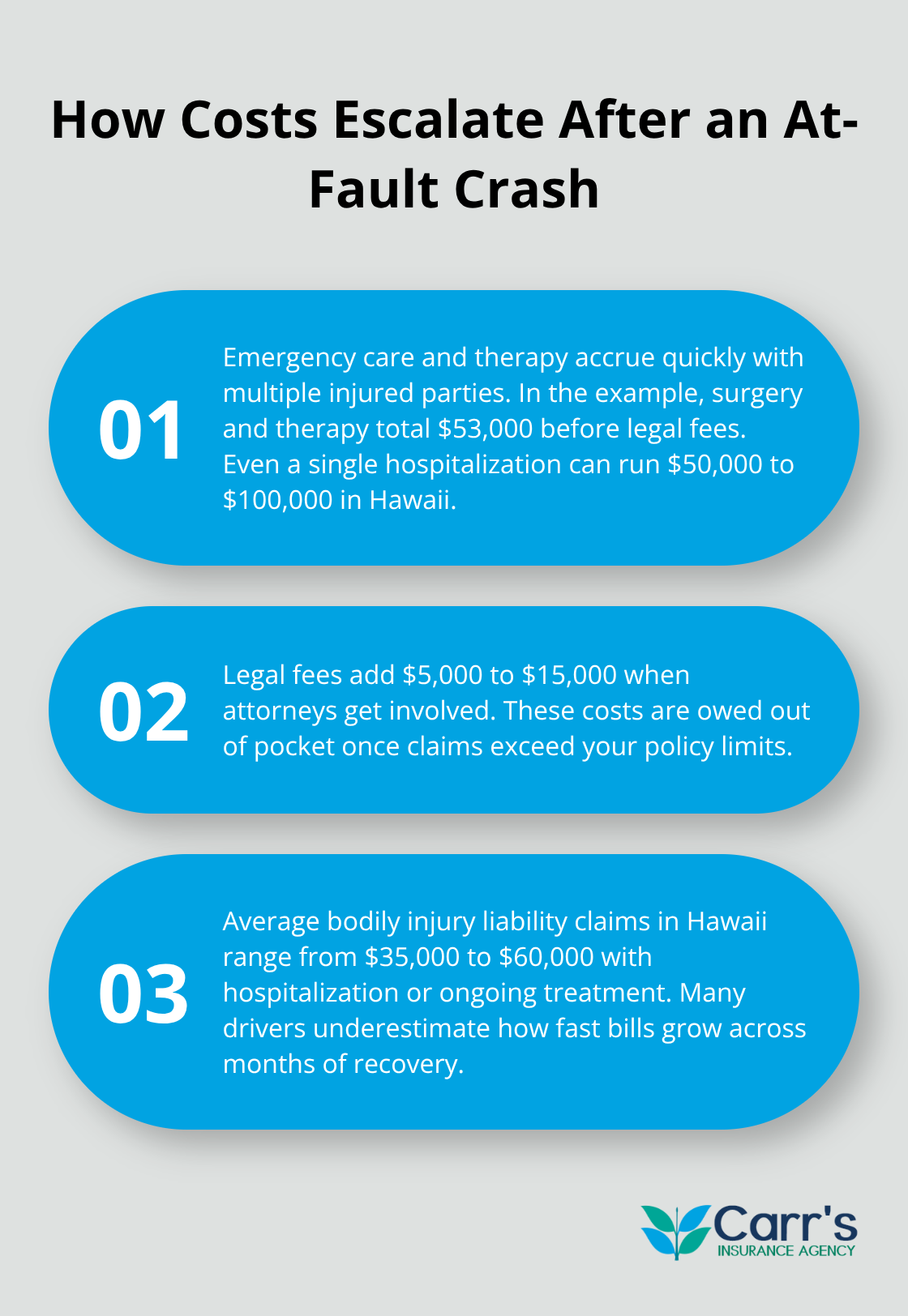
A single at-fault accident in Hawaii can drain your finances faster than you’d expect. Consider a realistic scenario: you rear-end another vehicle on the H-1 near Pearl City, injuring the driver and passenger. The driver requires emergency surgery costing $45,000; the passenger undergoes physical therapy for six months at $8,000.

Three ways expenses mount after an at-fault accident in Hawaii - Hawaii vehicle liability insurance

Combined medical expenses total $53,000, which already exceeds Hawaii’s $80,000 bodily injury per accident minimum. You now owe $13,000 out of pocket. If either injured party hires an attorney, legal fees add another $5,000 to $15,000 in costs you must cover. The injured parties can garnish your wages for years to recover these amounts.

This scenario isn’t hypothetical. The Insurance Information Institute reports that the average liability claim for bodily injury in Hawaii runs between $35,000 and $60,000 when injuries require hospitalization or ongoing treatment. Most drivers underestimate how quickly medical bills accumulate when multiple people suffer injuries or when treatment extends over months.

Property Damage to Other Vehicles or Infrastructure

Property damage claims escalate just as quickly when you hit the wrong vehicle or structure. Damage to a luxury car on Waikiki’s streets can easily reach $25,000 to $40,000 in repair costs, instantly exceeding the $20,000 state minimum. Strike a commercial storefront, utility pole, or parked vehicle with expensive modifications, and repair bills climb to $50,000 or more. Your personal assets remain at risk when accidents exceed your policy limits.

Legal Defense Costs and Lawsuits

Legal defense costs compound these expenses further. When an injured party files a lawsuit, your insurer typically covers attorney fees and court costs, but only up to your policy limits. If your coverage is inadequate, you pay out of pocket for additional legal representation. The financial aftermath lasts years once creditors pursue judgment liens against your paycheck, savings, and home.

Why Higher Limits Matter

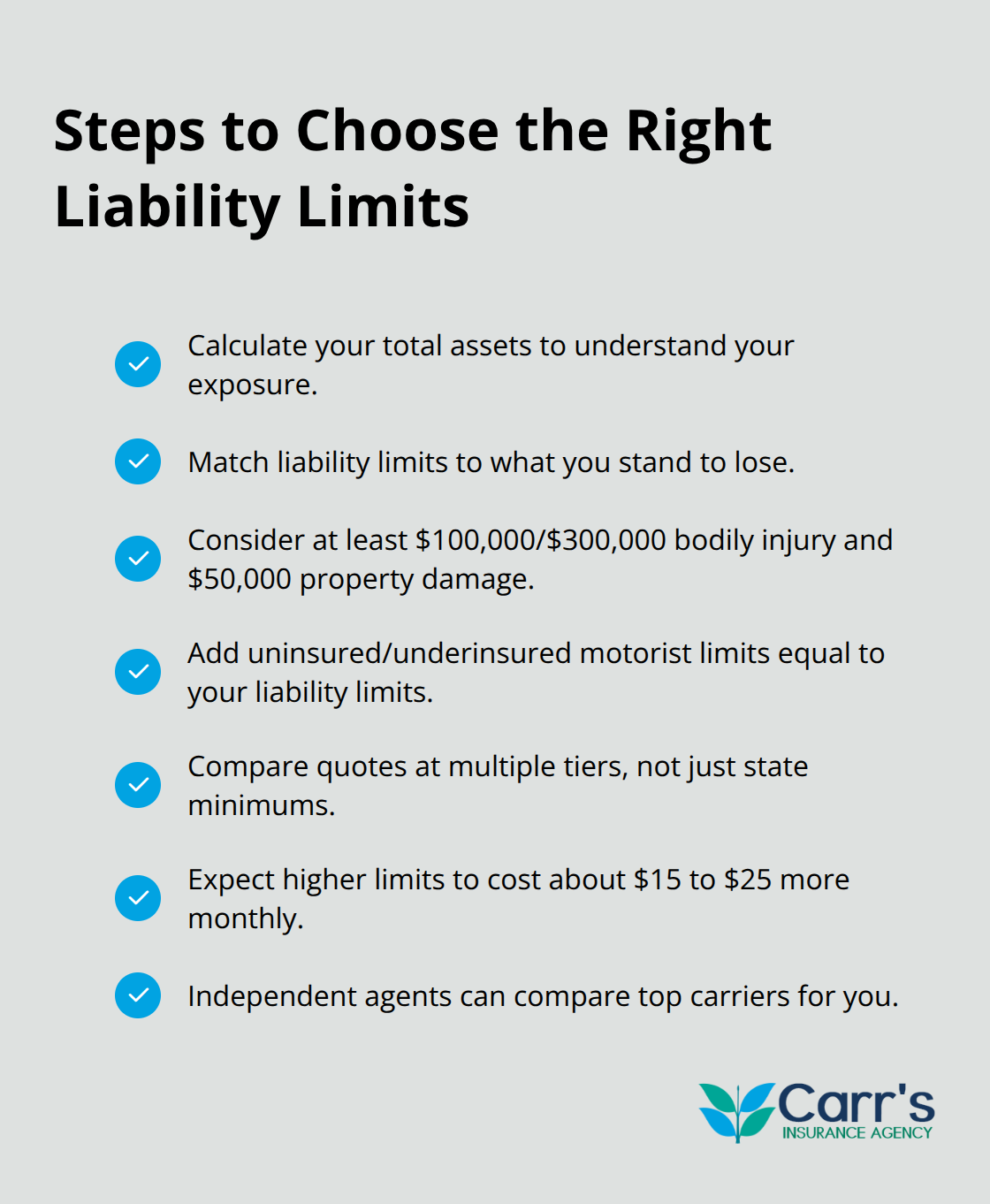
Try carrying at least $100,000 in bodily injury coverage per person and $300,000 per accident, plus $50,000 in property damage liability. These higher limits cost roughly 15 to 25 percent more annually but protect your financial future from creditors. The difference between minimum coverage and adequate protection becomes painfully obvious when an accident happens and medical bills or repair costs exceed what your policy covers. Understanding your exposure helps you make informed decisions about the coverage you actually need.

How to Choose the Right Liability Limits for Your Situation

Assessing Your Assets and Financial Exposure

The gap between Hawaii’s minimum liability limits and actual accident costs creates a dangerous financial trap for most drivers. Your job isn’t to meet state requirements-it’s to protect yourself from losing everything when an accident exceeds those minimums. Start by calculating your total assets: savings accounts, investment accounts, vehicle equity, home equity, and retirement accounts. This number represents your exposure. If you have $300,000 in assets and carry only Hawaii’s minimum $20,000 bodily injury per person coverage, creditors can pursue $280,000 in additional claims against your wages and bank accounts for years after an accident.

The math is straightforward: your liability limits should reflect what you stand to lose, not what the state mandates. Most Hawaii drivers with significant assets should carry at least $100,000 per person and $300,000 per accident in bodily injury coverage, plus $50,000 in property damage liability. This combination costs roughly $50 to $80 more annually than minimums but shields you from catastrophic financial exposure. Drivers with minimal assets can reasonably stop at $50,000 per person, $100,000 per accident, and $25,000 property damage-though even this exceeds Hawaii’s inadequate state minimums.

Understanding Uninsured and Underinsured Motorist Protection

Uninsured and underinsured motorist coverage layers additional protection onto your policy that many Hawaii drivers overlook entirely. This coverage pays your medical bills and repair costs when another driver causes an accident but lacks sufficient insurance to cover damages. Hawaii doesn’t require this coverage, which represents a significant gap in protection. In 2023, 15.4 percent of motorists were uninsured, meaning one in seven drivers on the road cannot cover damages they cause.

If an uninsured driver hits you and causes $50,000 in injuries, you’re stuck pursuing that driver’s personal assets-a slow, expensive process that often yields nothing. Underinsured motorist coverage handles this scenario instead, protecting you when the at-fault driver’s liability limits fall short of your actual damages. Carry uninsured motorist coverage equal to your liability limits; if you’re carrying $100,000 bodily injury liability, carry $100,000 uninsured motorist coverage as well. The additional premium typically runs $10 to $20 monthly and represents one of the best financial decisions you’ll make.

Comparing Coverage Options Across Carriers

When comparing carriers for your final policy, request quotes at multiple coverage levels: Hawaii’s minimum limits, $50,000 per person, and $100,000 per person. Most insurers quote these tiers automatically, and the premium differences will surprise you. The cost difference between $20,000 and $100,000 bodily injury coverage often amounts to only $15 to $25 monthly, making higher limits the obvious financial choice for protecting your future.

Checklist for selecting auto liability limits and UM/UIM in Hawaii

As a locally owned, independent agency serving Hawaii since 1990, Carr’s Insurance Agency compares rates across top carriers to help you find the right coverage at the best price-with licensed, locally knowledgeable agents who understand Hawaii’s specific risks and your personal situation.

Final Thoughts

Hawaii vehicle liability insurance protects your financial future far more than your legal standing. The gap between state minimums and actual accident costs creates real financial danger for most drivers, since average liability claims in Hawaii run $35,000 to $60,000 when injuries require hospitalization. Carrying only $20,000 bodily injury per person leaves you vulnerable to wage garnishment, asset seizure, and years of financial hardship when a single accident exceeds those limits.

Start by calculating your total assets and matching your liability limits to what you actually stand to lose. Request quotes at multiple coverage levels from different carriers to see how affordable higher limits truly are-the additional premium typically costs only $15 to $25 monthly compared to minimums. Add uninsured motorist coverage equal to your liability limits, since one in seven Hawaii drivers lack adequate insurance.

Carr’s Insurance Agency compares rates across top carriers to find you the right coverage at the best price. Our licensed, locally knowledgeable agents understand Hawaii’s specific risks and work with you to build a policy that actually protects your situation. Contact us today to review your current coverage and match your liability limits to your financial exposure.

Disclaimer: The information provided in this blog is for general informational purposes only and does not constitute legal, financial, or insurance advice. Coverage options, terms, and availability may vary. Please consult with a licensed professional for advice specific to your situation
Logistics Company Insurance Hawaii: Coverage for Your Operations

Logistics Company Insurance Hawaii: Coverage for Your Operations

Running a logistics operation in Hawaii means managing complex risks across vehicles, cargo, and employees. At Carr’s Insurance Agency, we understand that logistics company insurance in Hawaii requires more than basic coverage.

Your fleet, warehouse, and team all need protection tailored to your specific operations. This guide walks you through the essential coverage types that keep your business running smoothly.

Commercial Auto Insurance for Your Fleet in Hawaii

Understanding Fleet Coverage Basics

Commercial auto insurance forms the foundation of fleet protection, yet most logistics operations in Hawaii carry inadequate coverage because they misunderstand what their policies actually cover. We see companies underestimate their exposure to liability claims, physical damage costs, and regulatory penalties. Your delivery trucks, box vans, and cargo vehicles face unique risks-from third-party accident claims to cargo loss during transport-that personal auto insurance simply won’t handle. The National Highway Traffic Safety Administration reported that 5,936 people killed in traffic crashes involving large trucks in 2022, underscoring why proper fleet coverage isn’t optional.

Liability Protection Requirements

Commercial auto policies protect your business against liability claims when your driver injures someone or damages their property. They also cover repairs or replacement if your vehicles are damaged in accidents and meet Hawaii’s minimum liability requirements of 20/40/10 (20,000 dollars bodily injury per person, 40,000 dollars per accident, 10,000 dollars property damage). Without this coverage, a single accident involving your delivery truck could trigger lawsuits that exceed your company’s annual revenue.

Physical Damage Coverage for Hawaii Operations

Physical damage coverage on your fleet vehicles breaks into two components: collision coverage pays for repairs when your truck hits another vehicle or object, while comprehensive coverage handles theft, weather damage, vandalism, and other non-collision losses. Hawaii’s weather patterns create specific risks-salt air accelerates rust and corrosion on vehicle frames, and seasonal heavy rains increase accident frequency, particularly on routes through mountainous areas. Logistics companies operating in Hawaii should evaluate whether stated-value or actual cash-value coverage makes sense for their fleet age and replacement costs. A 2024 analysis by the American Trucking Associations found that average commercial vehicle repair costs increased 12 percent year-over-year, making physical damage coverage decisions more critical to your bottom line.

Chart showing 12% year-over-year increase in average commercial vehicle repair costs, emphasizing need for physical damage coverage decisions in Hawaii logistics.

Hired and Non-Owned Vehicle Protection

Liability protection extends beyond basic bodily injury and property damage to include hired and non-owned vehicle coverage, which protects you when employees use their personal vehicles for business purposes or when you rent equipment temporarily. This protection matters because Hawaii logistics operations often supplement owned fleet with rental vehicles during peak seasons or equipment breakdowns. Your policy should clearly specify whether it covers hired vehicles used for business, non-owned vehicles your employees operate, and any trailers or specialized equipment your operation uses regularly. Understanding these distinctions prevents coverage gaps that could expose your business to uninsured losses.

With fleet protection in place, your next priority shifts to safeguarding the cargo and facilities that keep your logistics operation running.

Business Property and Cargo Insurance for Your Hawaii Logistics Operation

Warehouse and Facility Coverage Protects Your Physical Assets

Your warehouse and facility coverage protects the physical structures where your logistics operation stores inventory, equipment, and vehicles when not in transit. This includes the building itself, roof, walls, and permanent fixtures, plus contents like shelving, forklifts, and office equipment inside. Hawaii’s climate creates specific exposure-salt air corrodes metal structures faster than mainland facilities, and seasonal storms bring wind and water damage risks that standard coverage often excludes without proper endorsements. You need coverage that addresses both sudden events like typhoons and gradual deterioration from humidity that can compromise your inventory.

In-Transit Cargo Protection Covers Your Goods on the Move

In-transit cargo protection covers goods while they move between your warehouse and customer locations, whether by truck, container ship, or air freight. Most logistics companies in Hawaii face serious gaps here because they assume their commercial auto liability handles cargo loss, when it typically covers only bodily injury and property damage to third parties, not your own goods. If your truck carrying electronics or food products gets damaged en route, your commercial auto policy won’t reimburse the cargo value-that’s what cargo insurance does.

Ordered list chart summarizing key points about in-transit cargo insurance for Hawaii logistics operations. - Logistics company insurance Hawaii

A 2023 report from the Council of Insurance Agents and Brokers found that cargo claims average significant amounts per incident, and many involve spoilage or weather exposure during transport that cargo policies specifically cover.

Equipment and Inventory Protection Extends Beyond Your Warehouse

Equipment and inventory protection extends beyond your warehouse walls to cover machinery, vehicles stored off-site, and stock held at customer locations or distribution centers. Hawaii logistics operations frequently store equipment at multiple locations, and each location needs explicit coverage in your policy. If you own forklifts, pallet jacks, generators, or specialized handling equipment, verify your property policy includes them by name or description, because generic coverage often excludes equipment with high replacement costs. Inventory sitting at a customer’s facility while awaiting processing or shipment creates liability exposure that your basic property policy may not address, requiring additional agreed-value or blanket coverage that accounts for fluctuating stock levels throughout the year.

Valuation Methods Determine What You Receive After a Loss

Replacement cost value and actual cash value are the two primary ways insurers calculate payouts, and this choice dramatically affects what you receive after a loss. Replacement cost value reimburses you for what it costs to replace damaged property at current market prices, while actual cash value subtracts depreciation from the replacement cost, meaning older equipment receives lower payouts. For Hawaii logistics operations with aging warehouse structures or vehicles, replacement cost coverage costs more upfront but prevents devastating underinsurance when you need to rebuild after a major event. Agreed value eliminates depreciation disputes by locking in a property value at policy inception, which works especially well for high-value cargo or specialized equipment where market prices fluctuate. The National Association of Insurance Commissioners data shows that commercial property claims often involve disputes over valuation, so choosing the right method before a loss occurs prevents negotiation delays when your business needs funds immediately to resume operations.

Coverage Gaps Create Financial Crises When Disasters Strike

Standard property policies exclude water damage from flooding, which matters because Hawaii’s geography creates flooding risk during heavy rains and storm surge events. You need separate flood insurance through the National Flood Insurance Program or private carriers, and waiting until after a storm warning appears means you cannot purchase coverage-most policies include 30-day waiting periods before protection activates. Spoilage coverage specifically protects perishable cargo from temperature fluctuations during transit or storage, and Hawaii’s tropical heat accelerates spoilage faster than cooler climates, making this endorsement essential for food or pharmaceutical logistics. Business interruption insurance covers lost income when a covered event forces your warehouse to shut down or your cargo fleet to stop operating, protecting your fixed costs like payroll and rent while you restore operations. Without this coverage, a major fire or equipment failure creates a financial crisis beyond just replacing the damaged property itself-your operation stalls while competitors capture your customers.

Workers Compensation and Specialized Coverage for Your Hawaii Logistics Team

Workers Compensation Protects Employees and Your Business

Logistics operations in Hawaii depend on employees who handle cargo, operate vehicles, and manage warehouse functions, making workers compensation insurance non-negotiable rather than optional. Hawaii requires employers with four or more employees to carry workers compensation coverage, and the Hawaii Department of Labor and Industrial Relations enforces strict compliance with penalties of not less than $500.00 or $100.00 for each employee for every day of non-coverage.

Hub-and-spoke chart outlining who needs workers compensation in Hawaii, penalties, what it covers, common injuries, average claim cost, and review practices. - Logistics company insurance Hawaii

When an employee suffers an injury-whether a back strain from lifting heavy cargo, a forklift accident in your warehouse, or a traffic injury while driving a delivery route-workers compensation covers medical expenses, rehabilitation costs, and wage replacement while they recover. The National Council on Compensation Insurance reports that the average workers compensation claim in Hawaii costs approximately 35,000 dollars across medical treatment and lost wages, and logistics operations face higher injury rates than many industries because of the physical demands of cargo handling and vehicle operation.

Your policy should cover all employees regardless of classification, and you need clear documentation of job duties for each position because insurers use this information to assess risk and calculate premiums accurately. Payroll changes, new equipment, and staffing shifts all affect your actual exposure and what you should pay for protection, so you should review your workers compensation coverage annually to stay aligned with your current operations.

General Liability Coverage Addresses Non-Employee Claims

General liability coverage protects your business when an employee, customer, or third party claims you caused their bodily injury or property damage through your business operations. This differs from workers compensation because it covers non-employee claims-for example, if a customer trips in your warehouse and breaks their leg, or if your delivery driver damages someone’s fence while backing up to make a delivery. Hawaii logistics companies face significant general liability exposure because customers, vendors, and the public interact with your facilities and vehicles regularly, and a single serious injury claim can exceed 500,000 dollars in medical and legal costs.

Your general liability policy should include products liability if you handle perishable goods, because spoilage or contamination claims fall under this coverage. You need contractual liability protection if customers require you to carry specific insurance before they’ll do business with you, and this endorsement prevents coverage disputes when third parties demand proof of your protection.

Tow Truck Insurance Covers Unique Bailee Risks

Specialized policies for tow truck operations require additional considerations because these activities create unique risks that standard commercial auto and general liability policies explicitly exclude. Tow truck insurance must cover bailee liability, which protects you when you hold a customer’s vehicle in your care and it gets damaged or stolen. Your policy should include coverage for the towed vehicle itself during transport because standard policies won’t pay for damage that occurs while you’re towing someone else’s car, and this gap leaves you personally liable for losses that exceed your reserves.

Hauling Services Need Pollution and Cargo Liability

Hauling services that transport oversized loads, hazardous materials, or specialized equipment need pollution liability coverage if you move chemicals or fuel. Cargo liability specifically covers goods you’re transporting for hire-different from in-transit cargo protection because you’re compensated for moving the cargo and assume responsibility for it during transport. This distinction matters because your customer expects you to protect their shipment, and your policy must reflect that you hold liability for loss or damage that occurs under your control (rather than covering only your own goods in transit).

Final Thoughts

Your logistics operation in Hawaii faces interconnected risks that require coverage working together seamlessly rather than functioning as separate line items. Commercial auto insurance, business property and cargo protection, workers compensation, and specialized policies create a comprehensive safety net that keeps your business running when accidents, weather events, or injuries strike. A company moving perishable goods faces different risks than one transporting general freight, and your warehouse location in a flood-prone area changes which endorsements matter most for your logistics company insurance Hawaii needs.

Start by documenting your current policies and identifying gaps where coverage doesn’t exist or limits fall short of your actual exposure. Review your workers compensation classification codes to confirm they accurately reflect your employees’ duties, because misclassification creates premium overpayment or underpayment that affects your cash flow. Calculate your potential loss scenarios-what happens if your warehouse floods, a delivery truck causes a serious injury, or your cargo spoils during transport-and verify your coverage limits can absorb those financial impacts without forcing your business to close.

We at Carr’s Insurance Agency have served Hawaii since 1990 as a locally owned independent broker, and we understand the specific risks that logistics companies face across our islands. Our agents compare rates from top carriers and work with you to build coverage that protects your operations without overpaying for protection you don’t need. Contact us to review your current coverage and identify where your business remains exposed to preventable financial losses.

Disclaimer: The information provided in this blog is for general informational purposes only and does not constitute legal, financial, or insurance advice. Coverage options, terms, and availability may vary. Please consult with a licensed professional for advice specific to your situation

Small Trucking Company Insurance: Protecting Your Growing Fleet

Small Trucking Company Insurance: Protecting Your Growing Fleet

Running a small trucking company means managing countless moving parts. Your vehicles, your drivers, and your cargo all need protection from the unexpected.

Small trucking company insurance isn’t just a legal requirement-it’s the foundation that keeps your business running when accidents happen. We at Carr’s Insurance Agency help trucking companies like yours find the right coverage without overpaying.

What Coverage Types Does Your Trucking Business Actually Need

Standard auto insurance won’t cut it for trucking operations. The liability limits on personal auto policies top out at $100,000 or $300,000-amounts that evaporate instantly when a truck causes serious injury or property damage on a highway. Commercial auto liability coverage for trucking companies starts at $750,000 and typically reaches $1 million or higher, which reflects the actual risk exposure. According to the Federal Motor Carrier Safety Administration, large truck crashes result in approximately 5,700 fatalities annually, and a single catastrophic accident can trigger settlements exceeding $2 million.

Key liability and loss figures that show why small U.S. trucking companies need higher limits - Small trucking company insurance

You need liability protection that matches this reality, not wishful thinking about avoiding accidents.

Commercial Auto Liability Covers the Real Costs

A serious trucking accident creates financial exposure that personal auto policies cannot handle. When your truck injures someone or damages property, the injured party’s legal team will pursue every available asset. Liability coverage protects your business, your personal assets, and your drivers from these claims. The $750,000 to $1 million range reflects what actually happens in catastrophic cases, not theoretical worst-case scenarios. Without adequate liability limits, a single accident could force your company into bankruptcy or personal financial ruin.

Physical Damage Coverage Keeps Your Fleet Running

Your trucks and equipment represent your company’s earning power. Physical damage coverage pays for repairs or replacement when your vehicles suffer damage from collision, weather, theft, or vandalism. Many small trucking companies carry minimal physical damage coverage to save on premiums, then face crippling downtime when a truck needs expensive repairs. A used commercial truck costs $40,000 to $80,000 to replace, and newer models run $100,000 or more. If your fleet sits idle waiting for repairs, you lose revenue immediately. Comprehensive and collision coverage should reflect your actual vehicle values and your ability to absorb downtime costs-typically meaning coverage limits that match replacement value rather than depreciated value.

Workers Compensation Protects Your Team and Business

Workers compensation is legally required in virtually every state if you employ drivers, mechanics, or office staff. According to the National Council on Compensation Insurance, the average workers compensation claim for trucking employees costs $42,000, though serious injuries can exceed $500,000. Beyond legal requirements, workers compensation protects your business from catastrophic liability when employees suffer job-related injuries. Without it, you face personal liability for medical bills, lost wages, and potential lawsuits that could bankrupt your operation. The coverage also provides rehabilitation benefits and wage replacement, which keeps injured workers financially stable and reduces the likelihood of litigation against your company.

Cargo and Bobtail Insurance Fill Critical Gaps

Cargo insurance protects the goods your trucks transport, covering loss or damage that occurs in transit. This coverage matters because your customers expect their shipments to arrive intact, and you’re often liable for losses even when accidents aren’t your fault. Bobtail insurance covers your truck when it operates without a trailer or cargo-situations that standard commercial auto policies often exclude. Many trucking companies overlook bobtail coverage, then discover they have no protection when a truck is involved in an accident while traveling empty between jobs. These specialized coverages address the unique risks that standard policies simply don’t recognize.

Your coverage needs extend beyond what most business owners initially expect, which is why the next section examines how to avoid the most expensive mistakes small trucking companies make when selecting their insurance strategy.

Key Coverage Types That Actually Protect Your Trucking Business

Cargo Insurance Shields Your Shipments and Reputation

Cargo insurance protects the goods your trucks transport while in transit, covering loss or damage regardless of fault in many cases. Your customers hold you responsible for shipments, and their contracts often require you to carry this coverage. Cargo theft costs the trucking industry more than $18 million per day, with individual shipment losses ranging from a few hundred dollars to hundreds of thousands depending on what you haul. If you transport electronics, pharmaceuticals, or high-value manufactured goods, cargo insurance isn’t optional-it’s the difference between a manageable loss and financial devastation.

Bobtail Insurance Covers the Trips You Forgot to Protect

Bobtail insurance covers your truck when it operates without a trailer or cargo, which is a blind spot many small operators miss entirely. Your commercial auto policy often excludes this scenario, leaving you unprotected when you travel between jobs, return from deliveries, or head to maintenance appointments. A single accident while bobtailing can result in liability claims your standard policy won’t cover, forcing you to pay out of pocket for injuries or property damage. This coverage matters most because you can’t predict when an accident will happen-it strikes during routine trips that feel safe but carry real financial risk.

General Liability Protects Your Operations Beyond the Road

General liability coverage protects against claims that arise from non-vehicle incidents on your property or operations. If a customer trips on your loading dock, a mechanic suffers an injury while servicing a vehicle, or your equipment damages someone’s property during a job, general liability steps in where auto policies don’t. The average general liability claim in the transportation industry costs between $10,000 and $50,000 according to industry data, but serious incidents involving premises liability can exceed $100,000. Many small trucking companies assume their commercial auto policy covers everything, then face unexpected out-of-pocket expenses when injuries happen off the road.

These three coverage types work together to eliminate the gaps that destroy unprepared trucking operations. Your specific operational risks determine which combination you actually need, which is why understanding your fleet’s unique exposures matters far more than accepting whatever a broker recommends without question.

How cargo, bobtail, and general liability work together to protect small trucking companies - Small trucking company insurance

The next section examines how to reduce what you pay for these essential protections without sacrificing the coverage your business depends on.

How to Actually Lower Your Insurance Costs Without Gutting Coverage

Bundle Policies to Slash Your Annual Premiums

Consolidating policies sounds like generic insurance advice, but the numbers prove it works for trucking companies willing to move forward. Small trucking operations save 15 to 25 percent on annual premiums when they bundle policies under one carrier instead of juggling three separate policies. The savings accumulate because insurers reward consolidated business with volume discounts, and you eliminate the administrative chaos of managing multiple renewal dates and different coverage terms.

Estimated premium reduction from consolidating trucking insurance policies under one carrier

Consolidation forces you to review your entire risk profile at once rather than renewing each policy in isolation, which is how gaps develop and costs spiral. The catch is that consolidation only works if you’re consolidating with a carrier that actually wants your business and prices competitively. Shopping around with three to five insurers before consolidating takes time but routinely reveals that one carrier’s consolidated quote beats another’s by thousands of dollars annually.

Drive Down Costs Through Safety Records and Telematics

Your drivers’ safety records directly control what you pay, and this is where most small trucking companies leave money on the table. Insurers use Motor Vehicle Records for every driver on your policy, and a single at-fault accident or moving violation can increase your premium 10 to 40 percent depending on severity and your carrier’s underwriting rules. The Federal Motor Carrier Safety Administration tracks safety violations, and those violations follow your company across carriers-you cannot escape a poor safety history by switching insurers.

A driver safety program that rewards clean records with bonuses and holds drivers accountable for violations typically reduces accident frequency by 8 to 15 percent according to transportation industry data, which translates directly to lower renewal quotes year after year. Some carriers offer telematics programs that monitor harsh braking, speeding, and unsafe cornering in real time, and insurers often discount premiums by 5 to 10 percent for fleets that adopt these systems because the data proves they reduce claims.

Avoid the Underinsurance Trap That Destroys Businesses

Underinsuring your fleet is the financial mistake that destroys small trucking operations faster than any other decision. Choosing coverage limits below what your actual exposure demands creates a false sense of savings that evaporates the moment a serious accident happens, leaving you personally liable for the difference between what insurance pays and what the injured party actually recovers.

Final Thoughts

Small trucking company insurance protects your business from the financial devastation that follows accidents, injuries, and cargo losses. The coverage types outlined in this article-commercial auto liability, physical damage, workers compensation, cargo insurance, bobtail coverage, and general liability-form the foundation that keeps your operation solvent when claims arrive. Skipping any of these protections creates exposure that will eventually cost far more than the premiums you tried to save.

Choosing the right insurance partner matters as much as selecting the right coverage. You need an agency that understands trucking operations, not one that treats your business like a standard commercial account. An independent broker who represents multiple carriers compares quotes across different insurers and finds pricing that reflects your actual risk profile rather than generic industry rates (this comparison process typically reveals significant premium differences for identical coverage).

Contact an insurance professional who specializes in trucking operations and request quotes for the coverage types outlined in this article. Provide accurate information about your fleet size, driver records, cargo types, and annual mileage so quotes reflect your real situation. Carr’s Insurance Agency stands ready to help you navigate these decisions and protect your growing fleet.

Disclaimer: The information provided in this blog is for general informational purposes only and does not constitute legal, financial, or insurance advice. Coverage options, terms, and availability may vary. Please consult with a licensed professional for advice specific to your situation
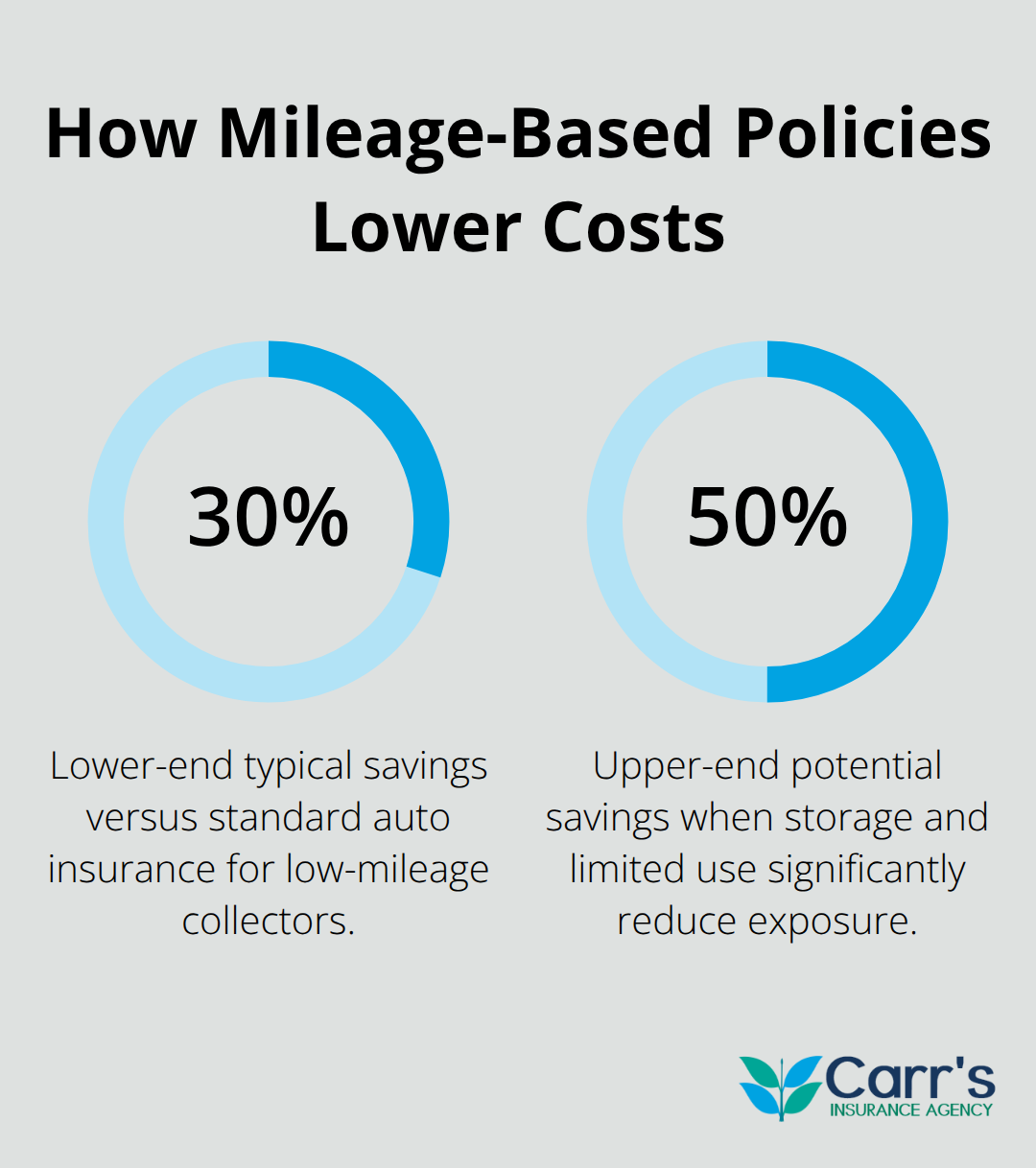
Commercial Trucking Policy Hawaii: Essential Coverage

Commercial Trucking Policy Hawaii: Essential Coverage

Running a trucking operation in Hawaii means navigating specific insurance requirements that protect your business and your drivers. A commercial trucking policy in Hawaii isn’t optional-it’s a legal requirement with state-mandated minimums and federal standards you must meet.

We at Carr’s Insurance Agency help trucking companies understand exactly what coverage they need and how to avoid overpaying for it. This guide walks you through the essential policies, cost factors, and practical ways to reduce your premiums.

What Hawaii Actually Requires for Trucking Operations

State-Mandated Liability Minimums

Hawaii’s Department of Transportation enforces strict liability minimums that differ from mainland requirements. For intrastate trucking in Hawaii, Hawaii mandates minimum bodily injury liability of $50,000 per person and $100,000 per accident, with property damage liability of $25,000. These numbers sound reasonable until you experience a serious accident-then they’re dangerously low. A single catastrophic injury claim can exceed these limits within seconds, leaving your business exposed to personal liability. We recommend carrying at least $500,000 in bodily injury coverage and $250,000 in property damage coverage, which costs significantly less than dealing with an underinsured claim.

Federal Requirements for Interstate Operations

If your operation involves interstate commerce, federal requirements jump substantially higher. The Federal Motor Carrier Safety Administration sets minimum liability at $750,000 for most trucking operations, and $5 million if you transport hazardous materials. These federal standards exist because trucking accidents cause real damage-the National Highway Traffic Safety Administration reported 4,485 large truck fatalities in 2022, with commercial vehicle accidents averaging $97,000 in damages per incident.

Uninsured Motorist and Physical Damage Protection

Most trucking operations need uninsured motorist coverage, which protects you when an uninsured driver causes an accident. Hawaii requires this coverage for personal vehicles, and it’s equally important for commercial trucks. Physical damage coverage matters tremendously in Hawaii’s environment-salt spray, humidity, and tropical storms accelerate vehicle deterioration. This protection prevents unexpected repair costs from disrupting your operations.

Cargo and Specialized Coverage Options

Cargo insurance protects the goods you haul, which is essential if you transport high-value freight. You should review your cargo limits annually because underinsuring inventory creates serious cash flow problems when losses occur. Hired and non-owned auto coverage extends your liability protection to vehicles you don’t own but operate for business purposes, which is critical if you rent equipment or borrow trucks temporarily. Motor truck general liability covers bodily injury and property damage beyond your vehicle’s direct involvement, protecting against accidents caused by cargo loading or unloading operations.

Understanding these coverage types sets the foundation for protecting your operation. The next step involves examining how different factors affect what you’ll actually pay for this protection.

What Coverage Actually Protects Your Trucking Operation

Liability Coverage Forms Your Foundation

Liability coverage forms the backbone of any trucking operation, and Hawaii’s minimum limits are genuinely insufficient for real-world accidents. A single serious injury claim costs $200,000 to $500,000 in medical expenses alone, which means Hawaii’s $50,000 per-person minimum evaporates instantly. We recommend minimum bodily injury liability of $500,000 per person and $1,000,000 per accident for intrastate operations, with property damage liability at $250,000. These limits cost roughly 15-20% more than minimums but eliminate the catastrophic risk of personal liability exposure. If you haul interstate, federal requirements demand $750,000 in liability coverage, and that’s non-negotiable with the Federal Motor Carrier Safety Administration.

The investment in adequate liability coverage is straightforward math: underinsuring your liability creates unlimited personal exposure when accidents happen, which they inevitably do in commercial trucking. A single catastrophic claim can bankrupt an operation that carries only state minimums.

Physical Damage Protection in Hawaii’s Environment

Physical damage coverage protects your actual trucks from repair costs that range from $15,000 for minor collisions to $80,000 for major frame damage on newer commercial vehicles. Hawaii’s salt air environment accelerates rust and corrosion, making regular maintenance essential but expensive. Comprehensive coverage prevents weather and accident damage from becoming financial emergencies that halt your operations. Your trucks represent your most valuable assets, and protecting them against the elements and collision damage keeps your business running without unexpected downtime.

Cargo and Specialized Coverage Layers

Cargo insurance becomes critical when you haul high-value freight, with coverage limits matching your actual cargo values rather than generic amounts. Hired and non-owned auto coverage protects you when you rent equipment or borrow trucks temporarily, which most operations do periodically. Motor truck general liability covers third-party bodily injury and property damage claims from cargo operations, loading accidents, or incidents beyond your vehicle’s direct involvement (such as injuries that occur during unloading at customer sites).

These coverage layers work together to address specific gaps that basic liability insurance misses, and skipping any of them creates operational vulnerabilities that show up at the worst possible moments. Understanding what each policy covers prepares you to make informed decisions about your actual costs.

What Drives Your Trucking Insurance Costs in Hawaii

Vehicle Age and Type Impact Your Premiums Most

Vehicle age and type create the largest swings in your premium, and older trucks cost significantly more to insure than newer models. A 2015 commercial truck might cost 40-50% more annually than a 2023 model with the same coverage limits, because repair costs climb dramatically as vehicles age and parts become harder to source. Newer trucks with advanced safety technology like automatic braking systems and lane departure warnings qualify for premium discounts ranging from 5-15% with most carriers.

Compact list of key factors that raise or lower trucking insurance costs in Hawaii

The truck’s cargo capacity matters too-a heavy-duty dump truck or flatbed hauling construction materials costs more to insure than a lighter commercial van because payload weight increases accident severity and damage potential. If you operate newer equipment with modern safety systems, your premiums reflect that investment through lower rates, which means upgrading aging trucks often pays for itself through insurance savings within 3-5 years.

Driver Safety Records Determine Fleet-Wide Costs

Your drivers’ safety records are the second-largest cost factor, and insurance providers monitor commercial driver records constantly. Drivers with clean records cost substantially less to insure than those with violations or accidents, so investing in driver training programs delivers immediate premium reductions. The National Safety Council reports that drivers completing defensive driving courses reduce accident rates by 10-15%, which insurers reward with rate discounts of 5-10%.

Bundling and Safety Technology Lower Your Rates

Bundling your commercial truck policy with other business coverage like general liability or workers compensation typically saves 10-20% on your overall insurance costs, making it financially sensible to consolidate policies with one carrier rather than splitting coverage across multiple insurers. Installing GPS tracking systems, dash cameras, and telematics devices that monitor driver behavior reduces premiums by 5-15% because insurers view these safety tools as accident prevention measures backed by concrete data.

Checklist of ways Hawaii trucking operations can reduce insurance premiums with typical U.S. discount ranges - Commercial trucking policy Hawaii

Calculate Your Potential Savings

The combination of newer vehicles, trained drivers with clean records, and modern safety technology can reduce your annual premiums by 30-40% compared to older equipment with minimally trained drivers, which represents thousands of dollars in annual savings that flow directly to your bottom line. These cost reductions stack on top of each other, so each improvement you make compounds the financial benefit across your entire operation.

Final Thoughts

Your commercial trucking policy in Hawaii requires three essential coverage layers: liability protection that exceeds state minimums, physical damage coverage for your vehicles, and specialized policies like cargo and hired auto coverage that address operational gaps. Carrying only Hawaii’s mandated minimums exposes your business to catastrophic personal liability when serious accidents occur, which is why we recommend liability limits of at least $500,000 per person for intrastate operations. These higher limits cost far less than the financial devastation of an underinsured claim.

Hub-and-spoke diagram of core insurance layers for trucking operations in Hawaii - Commercial trucking policy Hawaii

Comparing quotes from multiple carriers reveals significant price differences for identical coverage, with premiums varying by 30-50% depending on how each insurer evaluates your fleet, drivers, and safety practices. Local agents understand Hawaii’s specific insurance landscape and regulatory environment in ways that national call centers simply cannot match. An agent familiar with island operations knows which carriers offer the best rates for your particular situation and can identify discounts you might otherwise miss.

We at Carr’s Insurance Agency compare rates across top carriers to find the coverage and savings that fit your operation. Contact us to review your commercial trucking policy Hawaii coverage and learn how much you could save by optimizing your protection strategy.

Disclaimer: The information provided in this blog is for general informational purposes only and does not constitute legal, financial, or insurance advice. Coverage options, terms, and availability may vary. Please consult with a licensed professional for advice specific to your situation