

Contractor Truck Insurance Hawaii: Specialized Coverage for Jobsites
Running a contracting business in Hawaii means your trucks face unique risks that standard commercial auto policies simply don’t cover. From coastal salt damage to remote jobsite conditions, your vehicles need protection built specifically for how you work.
We at Carr’s Insurance Agency help contractors across Hawaii get the specialized coverage their fleets actually need. This guide walks you through contractor truck insurance in Hawaii and how to protect your business properly.
What Makes Contractor Truck Insurance Different
Standard commercial auto policies were built for businesses that operate vehicles on regular routes-delivery companies, sales teams, service fleets. They assume your trucks spend most time on paved roads between known locations. Contractor trucks operate in an entirely different world. Your vehicles sit on active jobsites, get loaded with expensive equipment, work in harsh coastal conditions, and face exposure to liability claims that typical commercial policies simply weren’t designed to handle. A standard commercial auto policy might cover your truck getting hit on the highway, but it won’t protect you when someone gets injured on your jobsite or when your equipment gets damaged during transport. This gap between what you actually need and what a basic policy covers is where contractors in Hawaii run into serious problems.
The Real Gaps in Standard Policies
Regular commercial auto insurance covers the vehicle itself and liability from accidents involving the truck. What it doesn’t cover is the specialized equipment you haul, the tools left on jobsites, or liability specific to construction work. If your truck carries a compressor worth $8,000 and it falls off the bed, your standard policy won’t touch it. If someone trips over your equipment on a jobsite and sues, your basic commercial liability won’t be adequate-contractors typically need $2 million in general liability coverage, but many standard policies max out lower or exclude construction-related incidents entirely. Hawaii’s maritime environment adds another layer of risk. The National Weather Service data shows Hawaii averages 6 tropical storms annually, and salt spray damage to vehicles in coastal areas costs contractors $2,000 to $5,000 per incident on average. Standard policies often exclude weather-related corrosion damage.
Hawaii Jobsite Conditions Demand Specialized Protection
Your trucks don’t just transport equipment-they’re mobile assets on active jobsites where liability exposure multiplies. A contractor vehicle parked at a residential remodel creates a liability risk in ways a plumber’s van on a service call doesn’t. Equipment theft from jobsites is rampant; Hawaii contractors report tools and materials worth $1,000 to $15,000 that go missing from unsecured sites monthly.
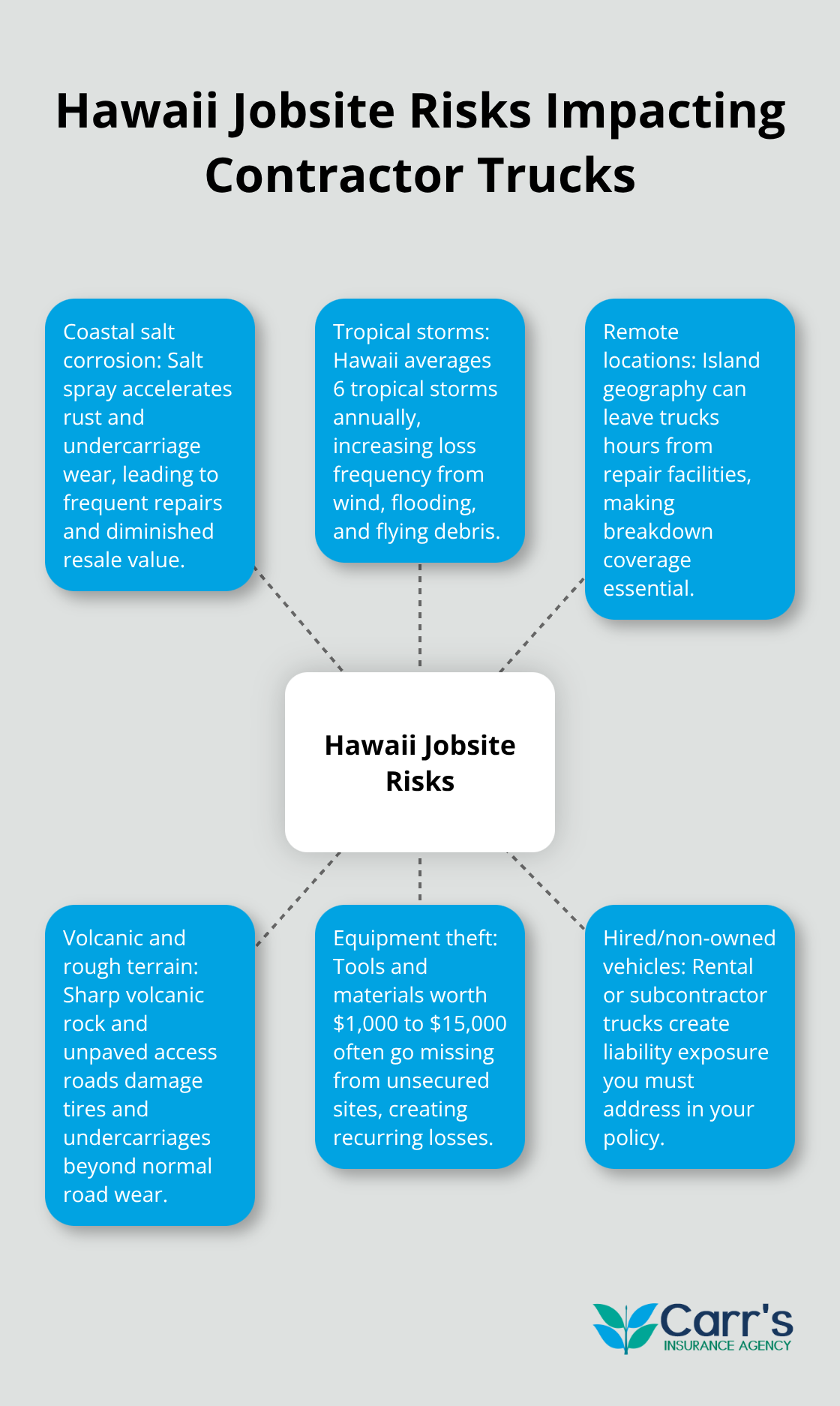
Your truck insurance needs to cover equipment in transit and at rest on jobsites. Remote locations on islands like Maui and the Big Island mean your trucks may be hours from repair facilities, and breakdown coverage becomes essential rather than optional. Specialized coverage also addresses hired and non-owned vehicle liability-if you rent equipment or hire subcontractors with their own trucks, you need protection against their accidents impacting your business. Hawaii’s unique jobsite environment (from volcanic rock surfaces that damage undercarriage to humid conditions that accelerate rust) requires carriers who understand local conditions, not national insurers that write generic policies.
Legal Requirements Specific to Hawaii Contractors
Hawaii Revised Statutes Chapter 431 requires all commercial vehicles to carry minimum liability coverage of $25,000 per person and $50,000 per accident for bodily injury, plus $25,000 for property damage. These minimums are laughably low for any serious contracting operation-a single injury lawsuit easily exceeds $100,000. Beyond state minimums, Hawaii’s Department of Labor enforces strict safety standards for contractor operations, and your insurance documentation proves compliance during inspections.
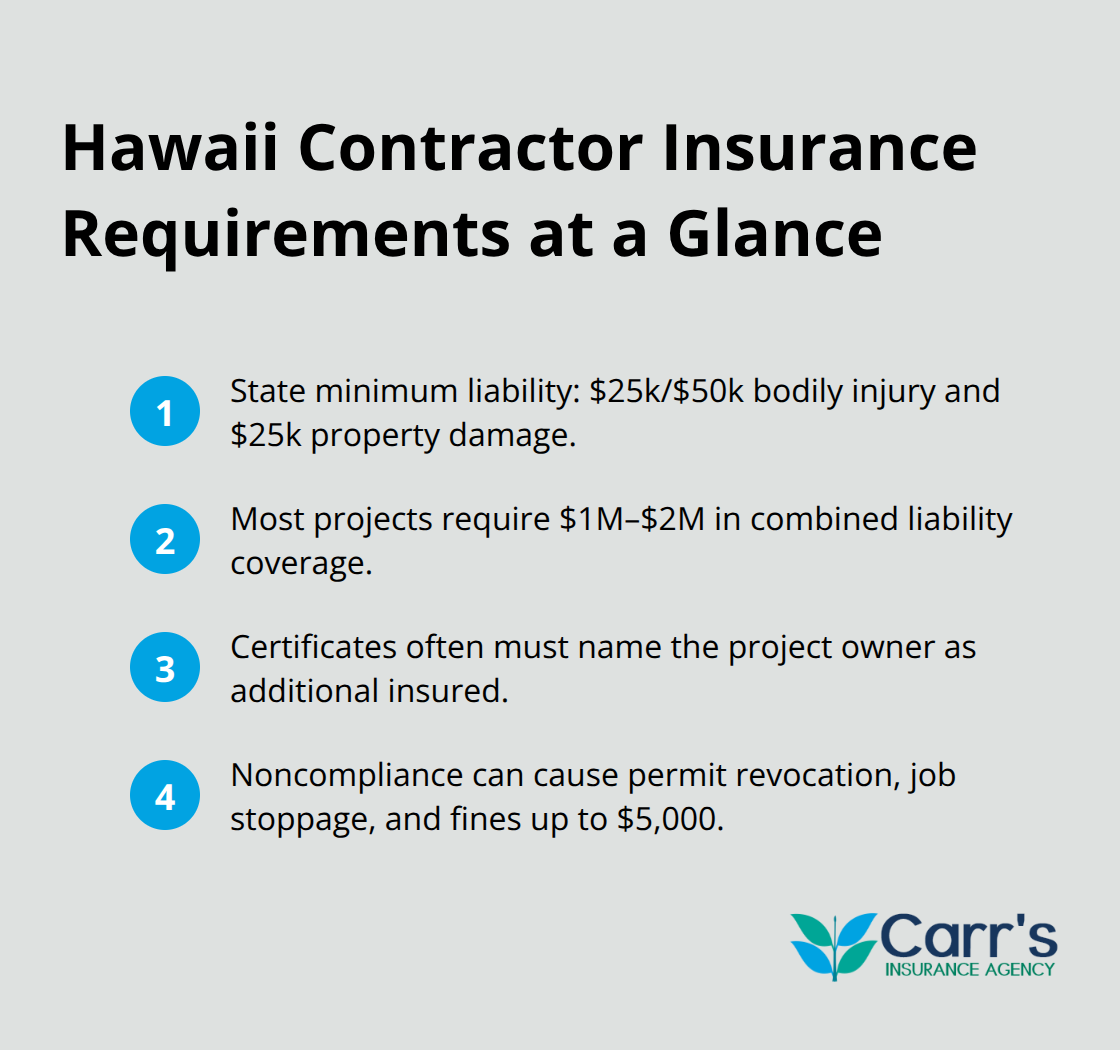
Most general contractors who work on residential or commercial projects need proof of $1 million to $2 million in combined liability coverage before you’re allowed on job sites. County permits in Honolulu, Maui, and Hawaii County often require certificates of insurance that name the project owner as additional insured before work starts. Failing to have proper contractor truck insurance doesn’t just leave you financially exposed-it can result in permit revocation, job stoppage, and fines up to $5,000. Understanding what your specific projects require matters far more than settling for minimum state requirements.
What Coverage Actually Protects Your Fleet
The gap between legal minimums and real-world protection is where contractors make costly mistakes. Your trucks need commercial auto liability that covers bodily injury and property damage claims from accidents, but they also need physical damage coverage that protects against theft, weather, and collision. Tools and equipment coverage (sometimes called inland marine coverage) protects the compressors, generators, and materials your trucks carry-coverage that standard policies exclude entirely. Workers compensation integrates with your truck insurance when employees operate vehicles or work from jobsites, and general liability coverage protects against third-party injury claims that happen on or near your vehicles. Hired and non-owned vehicle liability covers accidents involving rental equipment or subcontractor vehicles you don’t own but use for projects. The right contractor truck insurance policy stacks these coverages together in ways that address how you actually work, not how a delivery company or sales fleet operates.
Types of Coverage Contractors Need
Commercial auto liability forms the foundation of contractor truck insurance, but it represents only the starting point for operations in Hawaii. You need liability coverage that reaches at least $1 million per occurrence-most jobsite requirements demand this level, and state minimums of $50,000 leave you dangerously exposed. Physical damage coverage protects your truck against collision, theft, and weather damage, which matters intensely in Hawaii where salt corrosion and tropical storms cause substantial losses. The Insurance Information Institute reports that weather-related vehicle damage claims average $3,400 per incident nationally, and Hawaii’s coastal environment pushes that figure higher. Physical damage typically includes comprehensive coverage for theft and weather, plus collision coverage for accidents.
Choosing the Right Deductibles and Physical Damage Limits
A $500 deductible costs less in premiums but exposes you to repeated out-of-pocket losses on active jobsites. Most contractors operating multiple trucks should carry $1,000 deductibles to keep premiums reasonable while maintaining adequate protection. This balance protects your cash flow without sacrificing coverage when damage occurs. Higher deductibles work only if your business can absorb the immediate cost without disrupting operations or project timelines.
Tools and Equipment Coverage Protects Your Mobile Assets
Tools and equipment coverage is where most contractors face unexpected gaps because it doesn’t come standard with commercial auto policies. This inland marine coverage protects compressors, generators, power tools, and materials your trucks carry-the exact assets that disappear from jobsites or suffer damage during transport. Hawaii contractors lose approximately $1,000 to $15,000 monthly in equipment theft from unsecured sites according to local law enforcement reports, making this coverage essential rather than optional. Equipment coverage also protects against mysterious disappearance, which matters when tools vanish between jobsites without clear theft documentation.
Workers Compensation and General Liability Integration
Workers compensation and general liability integration rounds out your protection by covering employee injuries during truck operations and third-party injuries on jobsites near your vehicles. General liability should extend to $2 million combined single limit for serious contracting work, and workers compensation is legally mandatory in Hawaii if you have any employees. These three coverage types working together-commercial auto liability and physical damage, equipment protection, and integrated workers compensation with general liability-create a complete shield against the specific risks contractor trucks face in Hawaii’s jobsite environment.
The right coverage combination protects your fleet, but selecting the actual policy requires comparing what different carriers offer and understanding how their rates reflect Hawaii’s unique risks.
How to Choose the Right Contractor Truck Insurance Policy
Calculate your fleet value and equipment investment
Start with your actual fleet value and equipment investment, not just truck count. Most contractors underestimate what they carry on jobsites-a single truck with a compressor, generator, and hand tools easily represents $15,000 to $40,000 in mobile assets beyond the vehicle itself. Add up replacement costs for every piece of equipment your trucks transport regularly, then add 20 percent for items you occasionally haul. This total determines your equipment coverage limits, which directly impacts your premium.
A contractor with three trucks and $60,000 in equipment needs fundamentally different coverage than one with five trucks and $150,000 in gear. Insurance carriers price policies based on exposure, so accurately reporting your fleet composition and equipment value prevents both underinsurance and overpaying for coverage you don’t need. Many contractors discover they’ve been insuring equipment at half its actual replacement value, leaving themselves exposed when losses occur.
Request Quotes with Identical Coverage Terms
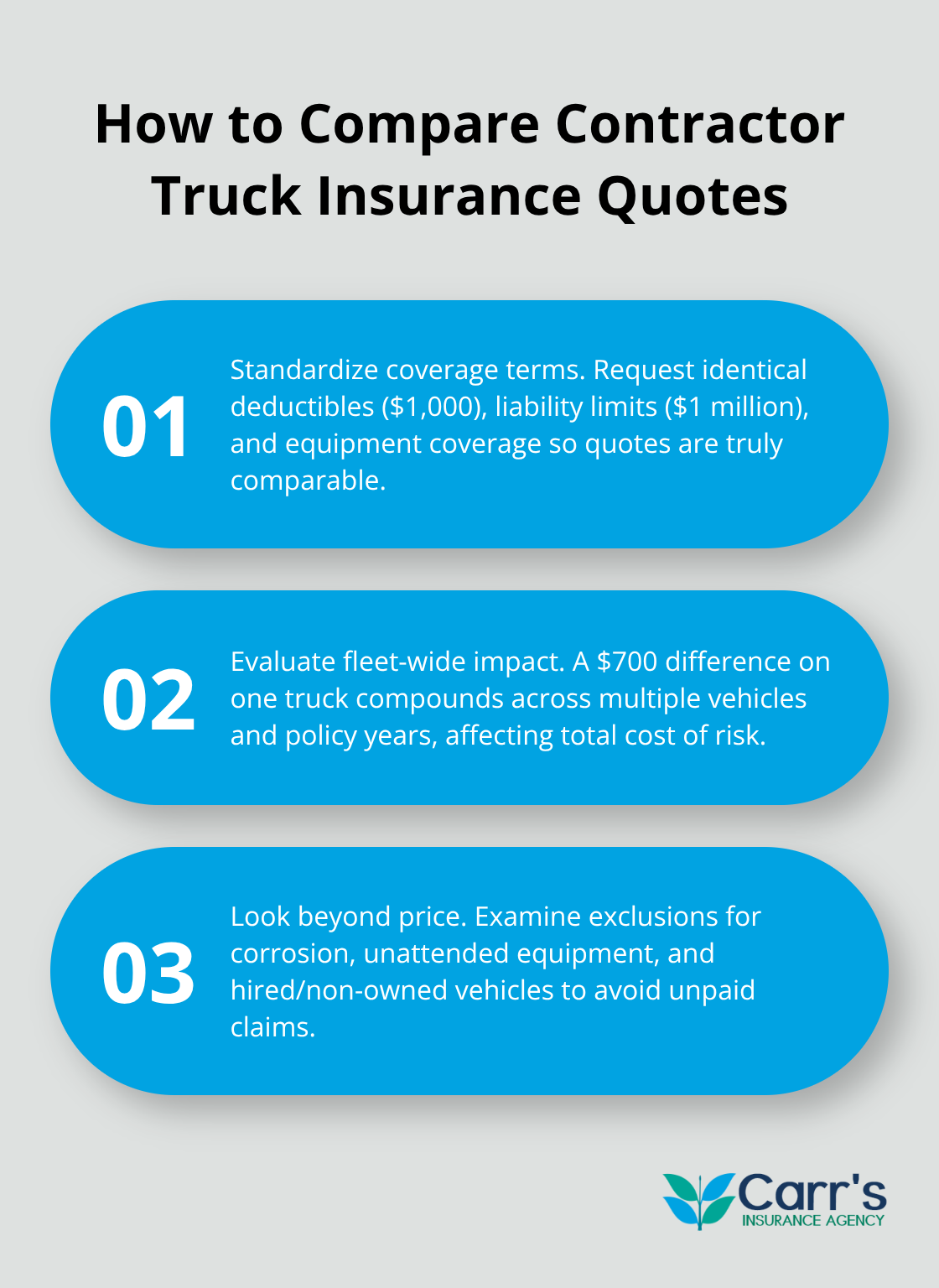
Multiple carriers reveal massive rate variations for identical coverage. Three carriers might quote you $2,400, $3,100, and $2,650 annually for the same commercial auto liability and physical damage on a single truck-a $700 difference that compounds across multiple vehicles. Request quotes with identical deductibles ($1,000), liability limits ($1 million), and equipment coverage amounts so you’re actually comparing apples to apples.
Carriers price contractor risk differently based on their loss history in Hawaii and their appetite for construction exposure. Some national insurers avoid contractor business entirely or charge premium rates because they lack local experience with jobsite conditions. Local agents who represent multiple carriers access quotes from insurers specializing in Hawaii contractor business, not just the national players.
Examine Policy Exclusions and Coverage Details
When comparing quotes, examine what each carrier excludes-some won’t cover equipment left unattended on jobsites, while others include mysterious disappearance coverage as standard. These policy details matter far more than a $200 premium difference because they determine whether your claim gets paid when damage actually happens. One carrier might exclude weather-related corrosion damage while another includes it as standard protection.
Ask each carrier specifically about coverage for hired and non-owned vehicles, equipment in transit versus at rest on jobsites, and whether they cover mysterious disappearance. A policy that costs $300 less annually but excludes your most common loss scenario (equipment theft from jobsites) leaves you financially exposed. The cheapest quote rarely represents the best value for contractor operations in Hawaii.
Work with an Agent Who Understands Local Jobsite Risks
An independent agent representing multiple carriers compares rates specifically for contractor operations, which means they find coverage options that national online quote systems never show. Agents with Hawaii experience understand how coastal conditions, remote island locations, and local jobsite practices affect your actual risk profile. They know which carriers specialize in contractor business and which ones treat construction as a secondary market.
Carr’s Insurance Agency, a locally owned independent agency serving Hawaii since 1990, represents top carriers and compares rates for contractor operations. As an independent broker, Carr’s accesses quotes from multiple insurers and delivers licensed, locally knowledgeable agents who provide personalized service to find the right coverage and save money. An agent who works with contractors regularly knows which carriers pay claims promptly and which ones create obstacles when you file.
Final Thoughts
Contractor truck insurance in Hawaii protects your entire business operation against the specific risks that jobsite work creates. Standard commercial auto policies leave dangerous gaps in coverage, and state legal minimums won’t keep you financially safe when equipment disappears from jobsites or someone gets injured on your project. The right policy combines commercial auto liability reaching $1 million or higher, physical damage protection that accounts for Hawaii’s coastal conditions, and equipment coverage for the tools and materials your trucks carry.
Your contractor truck insurance needs reflect your actual fleet size, equipment value, and the jobsite conditions you face across Hawaii’s islands. Comparing quotes with identical coverage terms reveals significant rate variations between carriers, and examining policy exclusions determines whether claims actually get paid when damage happens. An agent with local experience understands how tropical storms, salt corrosion, remote island locations, and equipment theft patterns affect your risk profile in ways national insurers simply don’t grasp.
Carr’s Insurance Agency, a locally owned independent broker serving Hawaii since 1990, represents top carriers and compares rates specifically for contractor operations. As an independent agency, Carr’s accesses quotes from multiple insurers and delivers licensed, locally knowledgeable agents who find the right coverage and save money through personalized service. Contact Carr’s Insurance Agency to calculate your total fleet and equipment value, then request quotes from carriers who specialize in contractor business rather than treating construction as a secondary market.
Disclaimer: The information provided in this blog is for general informational purposes only and does not constitute legal, financial, or insurance advice. Coverage options, terms, and availability may vary. Please consult with a licensed professional for advice specific to your situation






