

Hawaii Truckers Liability Insurance: What It Covers
Running a trucking operation in Hawaii means navigating specific insurance requirements that protect your business and your drivers. Hawaii truckers liability insurance isn’t optional-it’s a legal requirement that covers bodily injury, property damage, and medical expenses when accidents happen.
At Carr’s Insurance Agency, we help trucking companies understand exactly what their policies cover and what gaps might exist. The right coverage can mean the difference between a manageable claim and a business-threatening liability.
What Your Hawaii Trucking Liability Policy Actually Covers
Bodily Injury Liability: Why State Minimums Fall Short
Bodily injury liability forms the foundation of most Hawaii trucking claims, and the numbers reveal a critical gap. Hawaii’s state minimum requires $20,000 per person and $40,000 per accident, according to the Hawaii Department of Commerce and Consumer Affairs. That threshold sounds adequate until a serious injury claim arrives. A truck accident involving multiple vehicles or pedestrians can generate medical bills, lost wages, and pain-and-suffering awards that far exceed the minimum. A single serious injury easily reaches $50,000 to $100,000 or more. Many Hawaii trucking operations carry $100,000 per person or higher specifically because actual claim costs demand it. Paradise Insurance LLC data shows average liability losses in Hawaii run around $21,000 per claim-already exceeding the state minimum by $5,000. Your personal assets face exposure the moment your coverage limit runs out.
Property Damage Liability and the Real Cost of Collisions
Property damage liability covers the other vehicle, guardrails, utility poles, or building damage your truck causes. Hawaii’s $10,000 minimum is dangerously low. A single collision totals a newer vehicle worth $30,000 to $50,000 dollars.
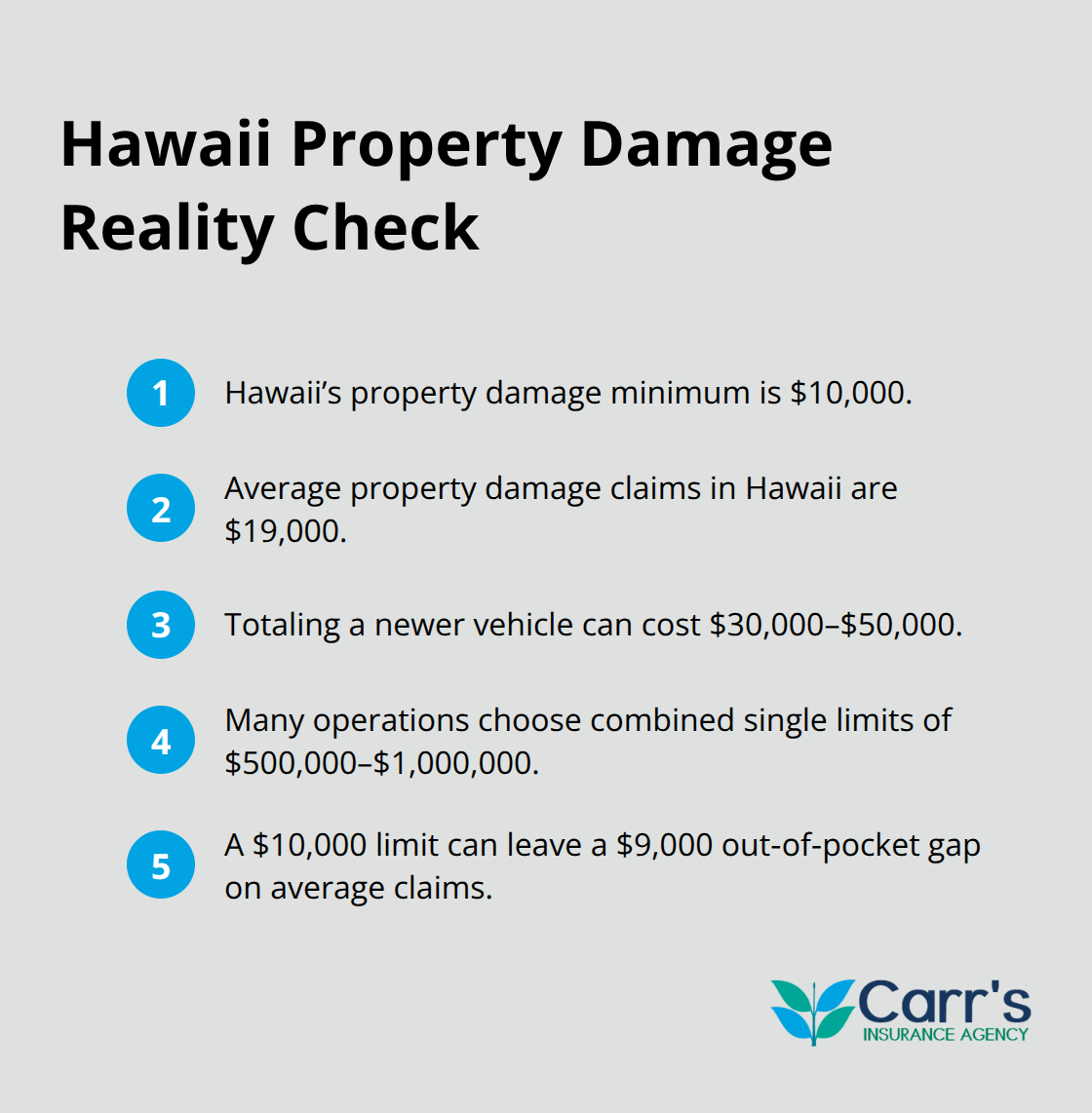
Property damage claims average $19,000 in Hawaii, according to Paradise Insurance LLC data. Your $10,000 limit leaves a $9,000 gap that your business must pay out of pocket. A truck hitting a commercial building or multiple vehicles can easily reach $40,000 to $60,000 in property damage alone. Higher coverage limits protect your equipment, your business assets, and your future earnings. Many Hawaii trucking operations operate with combined single limits of $500,000 to $1,000,000 specifically because potential exposure far outweighs the modest premium increase.
Medical Payments and No-Fault Coverage
Medical payments coverage operates separately from bodily injury liability and covers your driver and passengers regardless of fault. Hawaii mandates $10,000 in Personal Injury Protection, which covers medical expenses and lost wages for you and your passengers after any accident, even if you caused it. This no-fault coverage activates immediately and requires no proof of liability, making it fundamentally different from liability claims. Your driver receives treatment and wage replacement without waiting for fault determination or settlement negotiations.
The Real Cost of a Single Accident
A single at-fault accident involving injuries and property damage can easily reach $40,000 to $60,000 in total damages, exhausting your minimum coverage and leaving your business personally liable for the remainder. The gap between state minimums and actual claim costs is where most trucking operations face financial devastation. If you haul cargo, motor truck cargo coverage becomes critical-this protects the freight you transport if damage or loss occurs during transit. General liability coverage complements your commercial auto policy by protecting against injuries or property damage occurring on your premises or from your services, though it does not cover vehicle-related incidents.
Coverage Gaps That Catch Operators Off Guard
Food spoilage, product liability claims, and equipment breakdowns fall outside commercial auto insurance protection. Hawaii food truck operators and contractors need additional business owner policies to fill those gaps. Understanding what sits outside these policies matters as much as understanding what sits inside. The next section examines Hawaii’s specific regulatory requirements and how they shape your coverage obligations.
Hawaii and Federal Law Actually Require
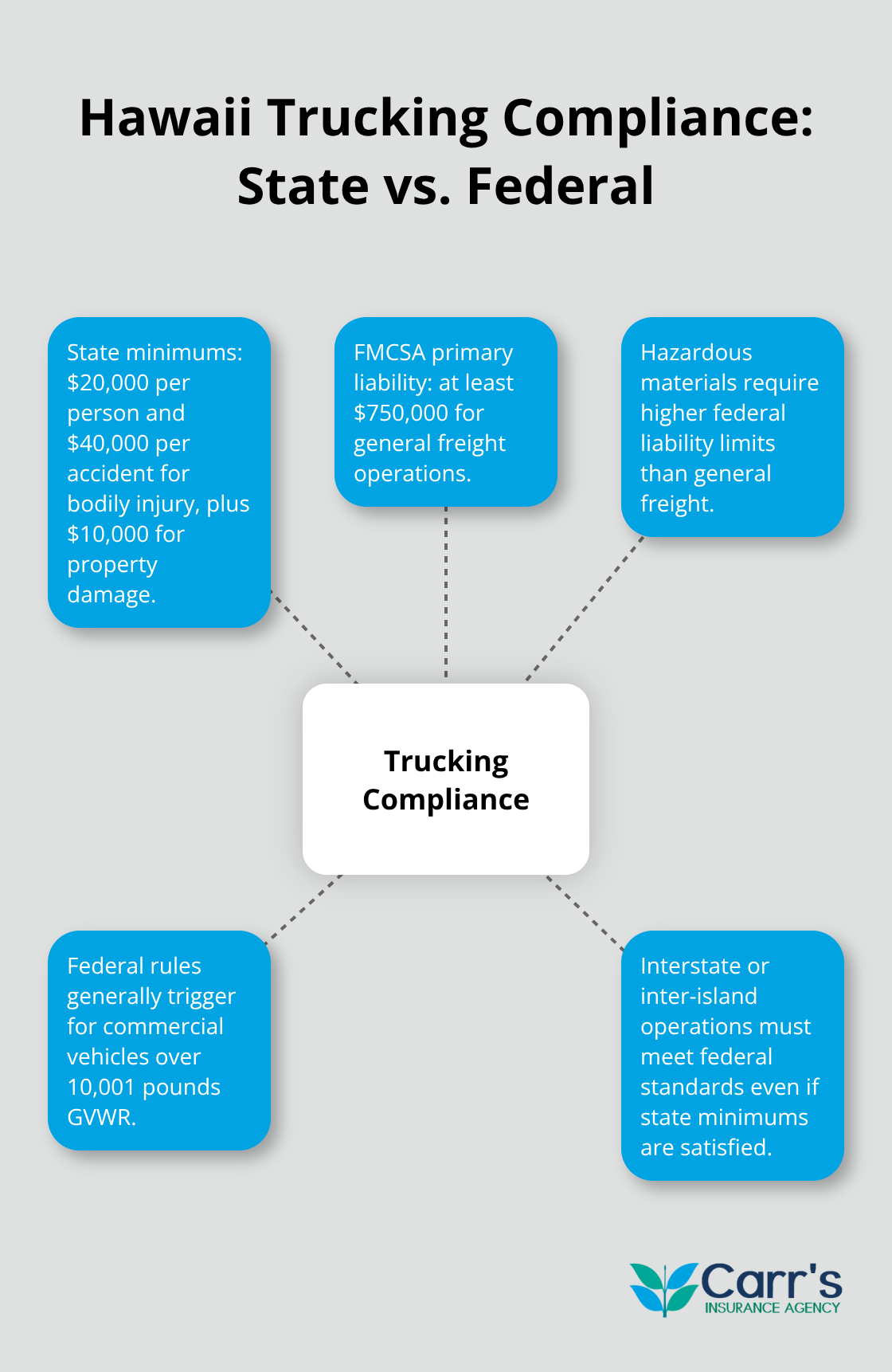
Hawaii’s regulatory framework for trucking operations sits at the intersection of state law and federal oversight, creating dual compliance obligations that many operators misunderstand. The Hawaii Department of Commerce and Consumer Affairs mandates minimum liability coverage of $20,000 per person and $40,000 per accident for bodily injury, plus $10,000 for property damage. These minimums apply to all commercial vehicles operating on Hawaii roads, regardless of cargo type or operation size. However, federal regulations through the Motor Carrier Safety Administration impose additional requirements that often exceed state minimums, particularly for interstate operations or vehicles over 10,001 pounds. The FMCSA requires primary liability coverage of at least $750,000 for general freight operations and higher limits for hazardous materials transport, creating a significant gap between what Hawaii law requires and what federal law demands.
State Minimums Versus Federal Standards
Operators who haul between islands or across state lines cannot rely on Hawaii minimums alone-federal standards become the binding requirement. This distinction matters because penalties for non-compliance include vehicle registration suspension, substantial fines, and potential federal citations that damage your carrier record permanently. Most Hawaii trucking operations face FMCSA oversight even if they operate primarily intrastate, since federal jurisdiction applies to any commercial vehicle over the weight threshold. The gap between $40,000 in state-mandated bodily injury coverage and $750,000 in federal requirements reflects the real exposure your operation carries. Operators who attempt to comply with only Hawaii law while ignoring federal thresholds face out-of-service orders and operating authority suspension.
Commercial Driver’s License and Medical Certification Requirements
Your Commercial Driver’s License status directly influences which coverage tiers apply to your operation. Hawaii requires CDL holders to maintain medical certification and pass federal background checks, obligations that insurance carriers use to assess risk. Drivers without current medical certificates face federal disqualification even if they hold a valid license, immediately voiding their ability to operate commercially and triggering coverage lapses. Insurance carriers will not write policies for drivers who lack valid medical certification, making this requirement non-negotiable for your operation.
MCS-90 Filing and Federal Documentation
The FMCSA Form MCS-90 filing requirement applies to most for-hire operations in Hawaii, documenting your insurance coverage with federal authorities and proving compliance before you legally operate. Failure to file or maintain current MCS-90 documentation results in out-of-service orders and operating authority suspension. Your policy should explicitly state compliance with FMCSA requirements rather than relying on standard commercial auto language-this distinction prevents coverage disputes when federal inspectors examine your documentation. The next section examines common claims and real-world scenarios that test whether your coverage actually protects your operation when accidents happen.
What Happens When Claims Actually Occur
Hawaii trucking accidents fall into three primary claim categories, and understanding how your coverage responds to each reveals whether your policy protects your operation or leaves you exposed.
Accident Liability Claims and Coverage Limits
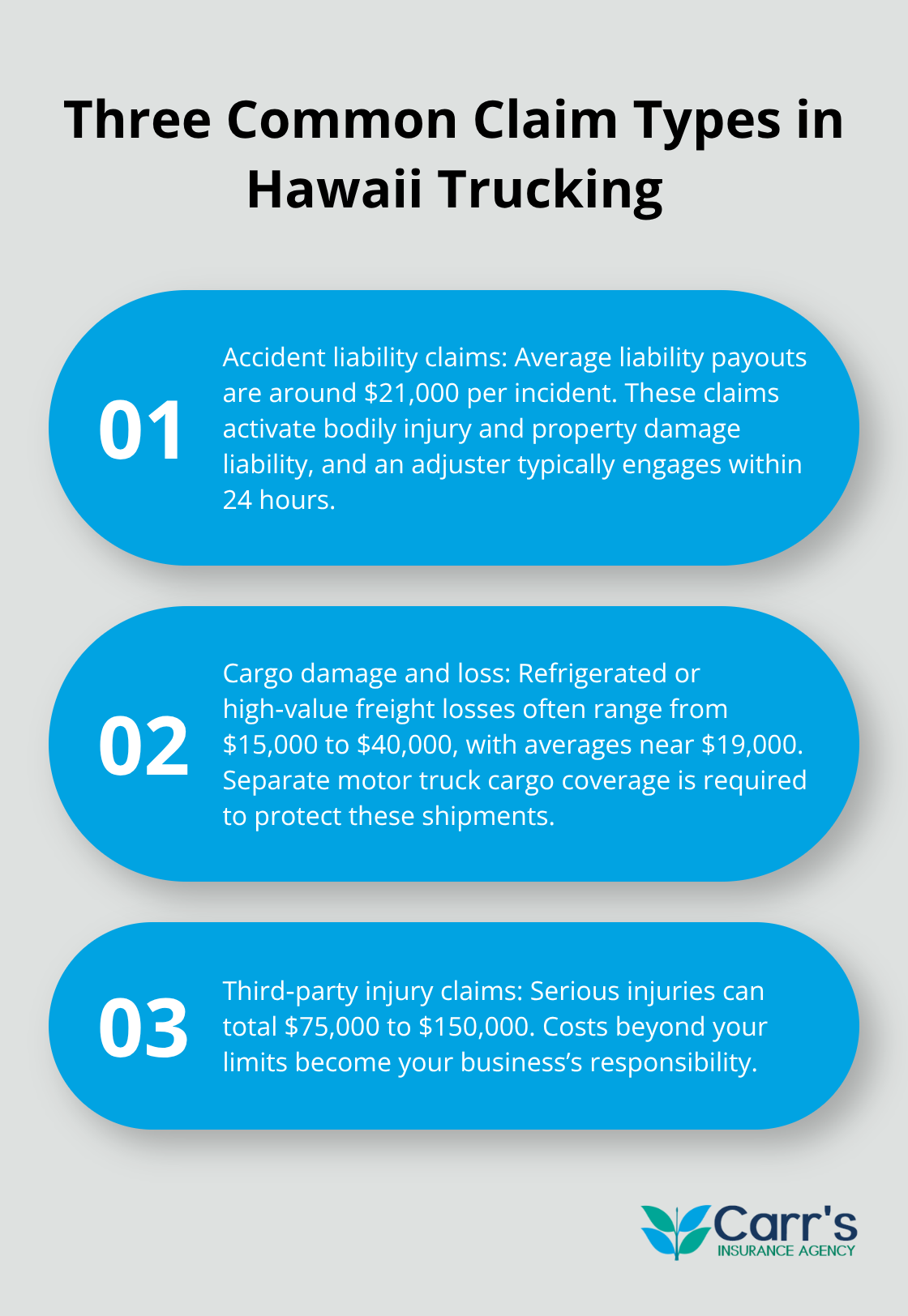
Accident liability claims dominate Hawaii’s trucking losses, with Paradise Insurance LLC data showing average liability payouts around $21,000 per incident. A truck collision on Oahu involving another vehicle, pedestrians, or fixed property triggers your bodily injury and property damage liability coverage immediately. Your insurer assigns a claims adjuster within 24 hours in most cases, and that adjuster determines fault, calculates damages, and negotiates settlement.
The claims process stalls when your coverage limits fall short of actual damages. A serious injury claim involving hospitalization, surgery, and lost wages routinely exceeds $50,000 to $100,000, leaving your business personally liable for amounts beyond your policy limits. Hawaii courts allow injured parties to pursue your personal assets, equipment, and future business income to satisfy judgments. Operators who carry only state minimums face this exposure constantly.
Cargo Damage and Loss Claims
Cargo damage and loss claims operate differently because they depend entirely on motor truck cargo coverage, which most operators purchase separately from their liability policy. A refrigerated truck carrying perishable goods loses its cargo due to mechanical failure or accident, and suddenly your business absorbs $15,000 to $40,000 in lost freight value. Without cargo coverage, that loss comes directly from your operating capital.
Paradise Insurance LLC reports average cargo losses around $19,000 in Hawaii, making this coverage essential for any operator transporting valuable goods. The cargo claim process requires documentation of the shipment value, proof of loss, and carrier responsibility determination. Your cargo policy pays these costs up to your selected limit, protecting your revenue stream when accidents or mechanical failures occur.
Third-Party Injury Claims and Personal Liability Exposure
Third-party injury claims arrive when your truck causes injuries to pedestrians, cyclists, or occupants of other vehicles. Medical expenses for serious injuries easily reach $75,000 to $150,000 when emergency care, hospitalization, and rehabilitation are included. Your bodily injury liability coverage pays these costs up to your policy limits, but exceeding those limits means your business pays the remainder.
A single catastrophic injury claim can bankrupt an operation carrying only state minimums. Hawaii’s no-fault Personal Injury Protection requirement means your own driver receives medical coverage immediately regardless of fault, but this protection does not extend to third parties injured in accidents you cause. The difference between adequate coverage and state minimums determines whether your operation survives a major claim or faces financial devastation.
Why Most Operators Exceed State Minimums
Successful Hawaii trucking operations carry limits far exceeding state minimums and maintain comprehensive coverage across liability, cargo, and physical damage categories. The gap between $40,000 in state-mandated bodily injury coverage and actual claim costs explains why experienced operators invest in higher limits. Paradise Insurance LLC data consistently shows that real-world claims exceed state minimums by substantial margins, making the modest premium increase for higher limits a sound business decision rather than an optional upgrade.
Final Thoughts
Hawaii truckers liability insurance protects your operation from financial devastation, but only when your coverage matches your actual exposure. State minimums of $20,000 per person and $40,000 per accident create a false sense of security that evaporates the moment a serious claim arrives. Real-world accidents in Hawaii generate liability costs averaging $21,000 for bodily injury and $19,000 for property damage-numbers that exceed state minimums before settlement negotiations even begin. Your business absorbs the difference between your policy limits and actual damages, meaning inadequate coverage transforms a manageable claim into a threat to your entire operation.
Federal FMCSA requirements demand $750,000 in primary liability for most operations, far exceeding Hawaii’s state minimums and establishing the baseline for any compliant policy. A food truck operator in Honolulu faces different risks than a long-haul trucker operating statewide, and your coverage should reflect those differences. Adding cargo coverage, physical damage protection, and general liability creates a comprehensive shield that protects your equipment, your freight, and your personal assets when accidents happen.
At Carr’s Insurance Agency, we represent top carriers and compare rates across multiple insurers to find Hawaii truckers liability insurance that protects your operation without overpaying. Our licensed agents handle the complexity of FMCSA compliance, MCS-90 filings, and coverage gaps so you focus on running your business. Contact us today for a quote that reflects your actual exposure rather than settling for minimum coverage that leaves your operation vulnerable.
Disclaimer: The information provided in this blog is for general informational purposes only and does not constitute legal, financial, or insurance advice. Coverage options, terms, and availability may vary. Please consult with a licensed professional for advice specific to your situation






