
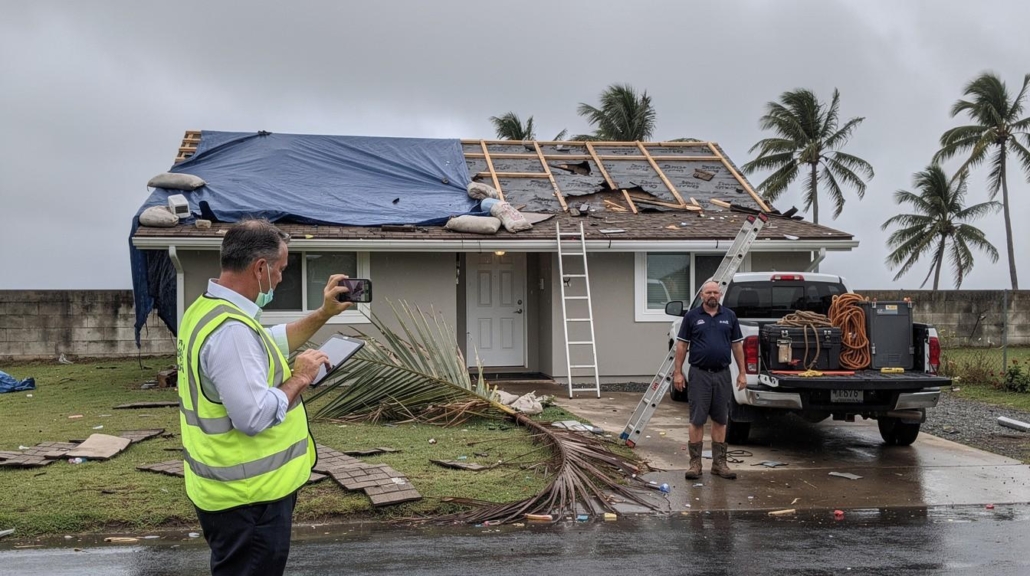
Storm Damage Insurance Hawaii: Ensuring Quick Recovery
Hawaii’s storm season brings real risks to your home and finances. At Carr’s Insurance Agency, we know that storm damage insurance in Hawaii isn’t just about having a policy-it’s about understanding what actually protects you when a hurricane or tropical storm hits.
This guide walks you through coverage options, claim filing steps, and practical ways to strengthen your property before the next storm arrives.
What Does Hawaii Storm Insurance Actually Cover
Hawaii’s storm threats are specific and severe, which means your coverage needs to be equally specific. Hurricane Iniki struck Kauai on September 11, 1992, with sustained winds around 130 mph and caused around $3.1 billion in property damage. That storm exposed a hard truth: standard homeowners policies in Hawaii often leave massive gaps when hurricanes or tropical storms hit.
Most basic homeowners policies cover wind damage from storms, but they typically exclude or severely limit coverage for water damage, storm surge, and flooding-the three biggest culprits in Hawaiian hurricane losses. Standard policies also rarely cover the secondary damage that follows, like mold remediation or temporary housing costs during repairs. Too many homeowners face these gaps after a storm arrives, when it’s far too late to add protection.
Wind Damage vs. Water Damage
Your homeowners policy likely covers wind damage, but the devil lives in the details. Wind-driven rain that enters through roof damage or broken windows typically falls under water damage exclusions, not wind coverage. This distinction matters enormously in Hawaii, where storm surge and heavy rainfall accompany most hurricanes.
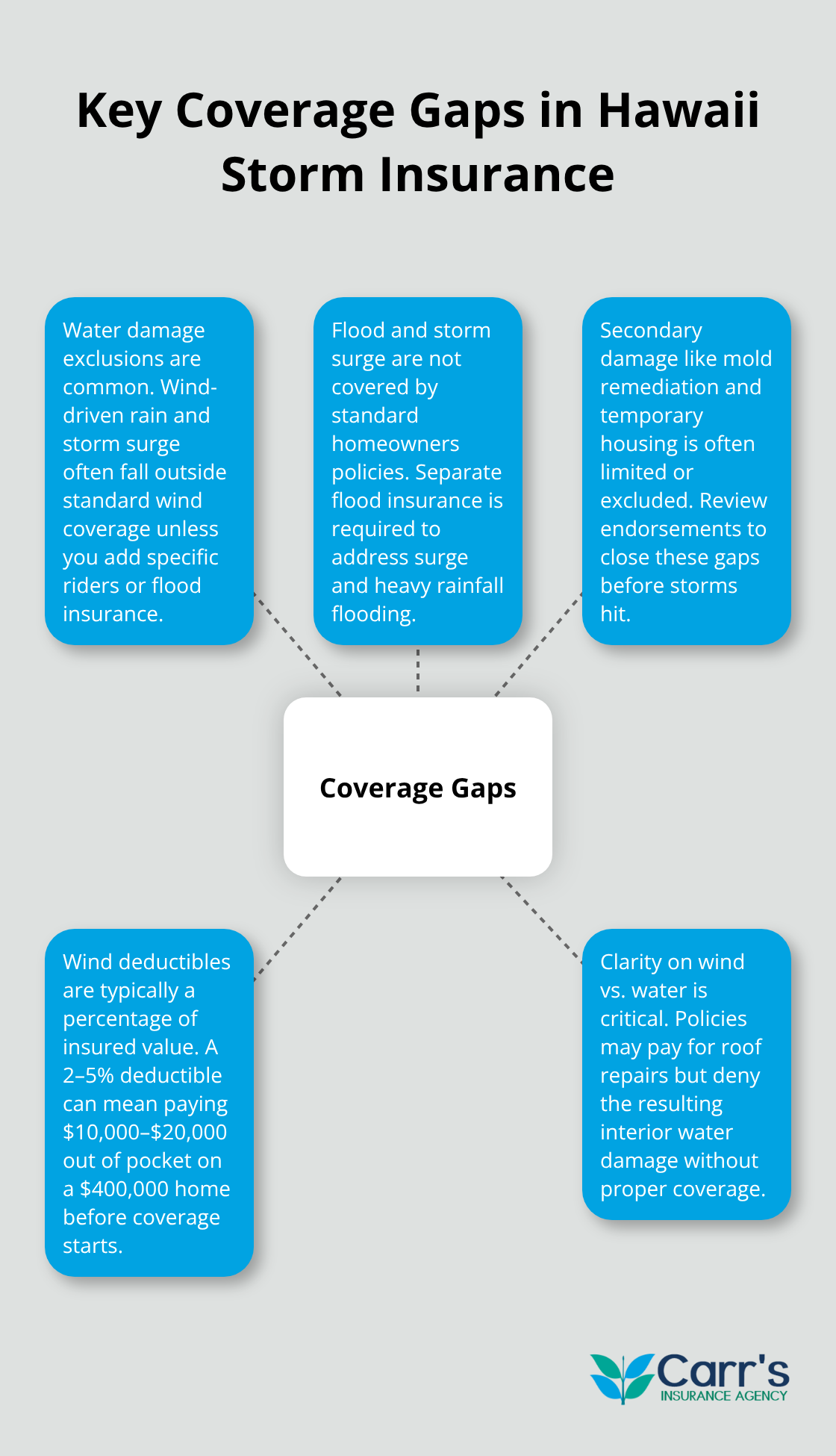
NOAA records show that past Hawaiian hurricanes like Iwa in 1982 and Iniki in 1992 caused catastrophic coastal damage through surge and flooding, not wind alone. Many homeowners discovered their policies paid for roof repairs but refused claims for the water that poured through those damaged roofs. You need explicit water damage or flood coverage added to your policy to address this gap.
Standard policies also cap wind deductibles at 2 to 5 percent of your home’s insured value, meaning a deductible could easily exceed $10,000 to $20,000 on a $400,000 home. That’s a significant out-of-pocket cost before insurance kicks in.
What You Must Add to Your Coverage
Hawaii-specific storm coverage requires three essential additions: flood insurance through the National Flood Insurance Program, water damage riders that cover rain intrusion during storms, and replacement cost coverage rather than actual cash value. Flood insurance stands separate from your homeowners policy and covers storm surge, heavy rainfall flooding, and overflow from nearby waterways.
Replacement cost coverage pays for repairs or replacement at current market prices, while actual cash value deducts depreciation-a critical difference when you rebuild after a hurricane. The topography of Hawaii’s islands funnels and concentrates winds across ridges and channels, increasing destructive force in certain areas.
If your home sits in a high-wind zone or coastal area, you may also need windstorm coverage, which protects against hurricane-force winds but requires a separate policy rider. Coverage limits matter too; many homeowners underinsure their properties, then face massive shortfalls when repair costs exceed their policy limits by thousands of dollars. Understanding these gaps now positions you to file claims effectively when storms strike.
How to File Your Storm Damage Claim Before It’s Too Late
Act Fast After the Storm Hits
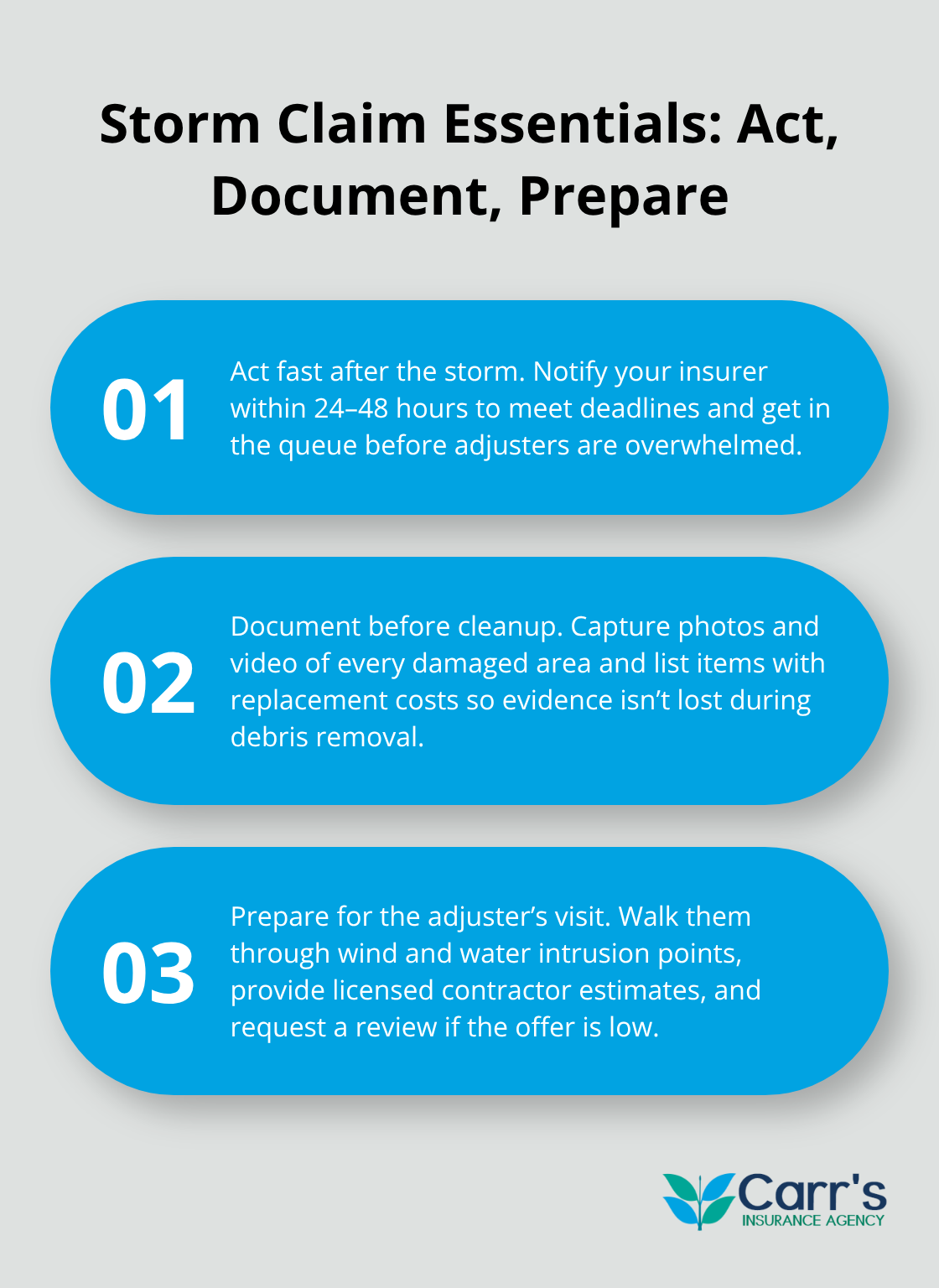
The first hours after a hurricane or tropical storm strikes your Hawaii home determine whether your insurance claim succeeds or fails. Your insurance company enforces strict timelines, and Hawaii’s storm season means adjusters get overwhelmed fast. Contact your insurer within 24 to 48 hours of the storm passing, even if you cannot fully assess damage yet. This immediate notification protects your claim and signals to your carrier that you take the loss seriously.
Document Everything Before Cleanup Starts
Photograph and video all damaged areas before you touch anything or start cleanup, because once debris removal begins, your evidence vanishes. Your insurer needs to see the damage in its raw state to process your claim fairly. Create a written list of every damaged item with approximate replacement costs, cross-referenced to your photos. Do not rely on your memory weeks later when the adjuster asks what was destroyed. Store all documentation digitally and physically in separate locations, because flooding or additional storms can destroy your records.
Prepare for Your Adjuster’s Visit
Most claim denials in Hawaii stem from inadequate documentation or homeowners filing without understanding what their policy actually covers. When your adjuster arrives, walk them through the property systematically and point out wind damage, water intrusion points, and secondary damage like mold growth or structural issues that emerged after water exposure. Adjusters work fast and handle multiple claims simultaneously, so your organized documentation keeps their attention on your legitimate losses.
Provide your adjuster with repair estimates from licensed contractors, not just your own guesses about costs. Hawaii contractors typically provide free assessments after storms, and obtaining three quotes protects you if your insurer’s estimate seems low. If your adjuster’s settlement offer falls short of your documented losses, request a detailed explanation of their calculation and ask for a second opinion through an independent adjuster or public adjuster. Never accept a settlement that feels incomplete just to speed up the process.
Strengthen Your Position with Professional Help
Your next step involves preparing your property to withstand future storms, which starts with understanding what structural vulnerabilities your home actually has.
Hardening Your Home Against Hawaii’s Storm Season
Hawaii’s building codes lag behind storm science, which means your home probably has structural vulnerabilities that contractors can fix before the next hurricane arrives. The topography of Hawaii’s islands funnels and concentrates winds across ridges and channels, turning certain neighborhoods into wind tunnels that exceed standard design pressures. Start with a structural inspection of your roof attachment, because this single point determines whether your home stays intact or loses its roof during a Category 3 hurricane.
Reinforce Your Roof and Walls
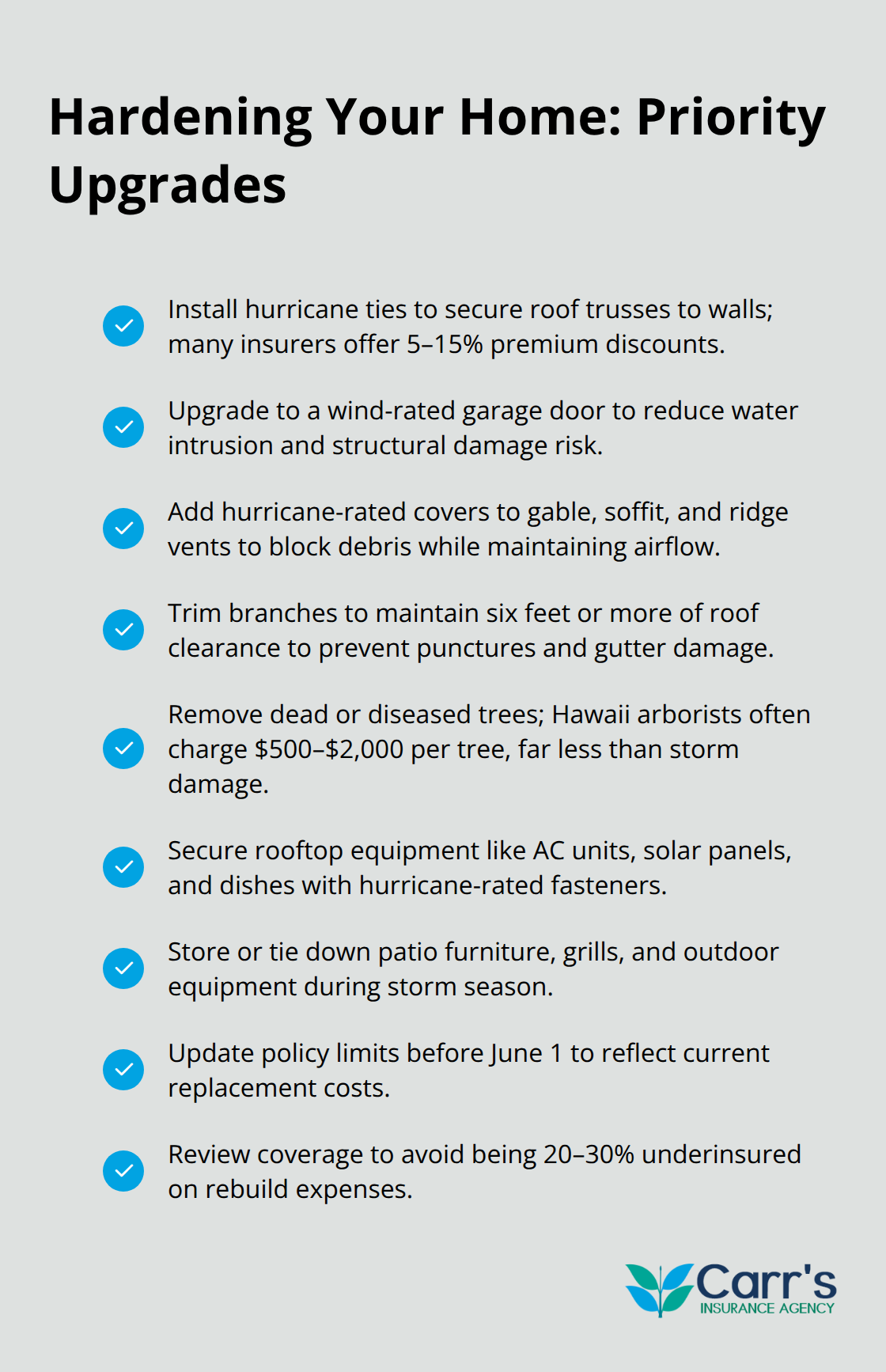
Hurricane ties connect your roof trusses to your walls and cost between $200 and $500 per home. These straps prevent the catastrophic failure that turns a manageable repair into total loss. Your insurance company may offer discounts of 5 to 15 percent if you install these reinforcements, which means the upgrades pay for themselves through premium reductions within two to four years.
Garage doors fail frequently in hurricanes, so replacing a standard garage door with a wind-resistant model costs $1,500 to $3,000 but prevents water intrusion that causes mold, electrical damage, and structural rot. Gable vents, soffit vents, and ridge vents need hurricane-rated covers that maintain ventilation while blocking debris. Your home’s perimeter also matters enormously; concrete block construction resists wind better than wood frame, but older Hawaii homes often have lightweight construction that makes wind-driven debris a major threat to the structure and neighboring properties.
Secure Your Outdoor Environment
Outdoor objects become projectiles in 130-mph winds, so your surroundings matter as much as your home’s structure. Trim tree branches that hang over your roof to six feet or more of clearance, because falling branches penetrate roofs and damage gutters in ways that trigger water intrusion claims. Remove dead or diseased trees entirely; arborists in Hawaii typically charge $500 to $2,000 per tree depending on size and location, and this expense prevents far costlier damage during storms.
Secure air conditioning units, solar panels, and satellite dishes to your roof structure with hurricane-rated fasteners, not standard mounting hardware. Patio furniture, grills, trash cans, and outdoor equipment need storage inside, heavy cable ties, or complete removal during hurricane season. These simple steps prevent your property from damaging neighboring homes when winds turn loose objects into weapons.
Update Your Coverage Before Storm Season
Update your coverage limits and policy details before June 1st, the official start of Hawaii’s hurricane season. Most homeowners underestimate their home’s replacement value by 20 to 30 percent, which leaves them short when contractors quote actual repair costs after a storm. Request a detailed policy review from a local independent agent who understands Hawaii’s specific risks and can compare rates across multiple carriers (Carr’s Insurance Agency, as a locally owned independent broker serving Hawaii since 1990, represents top carriers and provides personalized service to help you find the right coverage and save money).
Final Thoughts
Storm damage insurance in Hawaii protects your financial stability when hurricanes and tropical storms strike your home. Past storms like Hurricane Iniki caused over $2.3 billion in losses on Kauai alone, and Hawaii’s vulnerable building stock means your property faces real risk. Standard homeowners policies leave dangerous gaps, water damage exclusions create false security, and underinsured properties leave owners facing massive out-of-pocket costs after storms pass.
Your preparation strategy must address three concrete areas: understand exactly what your current policy covers and add flood insurance, water damage riders, and replacement cost coverage before hurricane season arrives; physically harden your home through roof reinforcements, garage door upgrades, and tree trimming (these investments reduce damage and often qualify for insurance discounts that offset their cost); and document your property’s condition now, photograph valuable items, and maintain organized records so claims move faster when storms hit. Timing matters enormously-waiting until June to review your coverage means adjusters are already overwhelmed with spring storm claims, waiting until August to trim trees means contractors are booked solid, and waiting until after a hurricane to add flood insurance means your claim gets denied because the policy wasn’t active when the storm struck.
Carr’s Insurance Agency has served Hawaii since 1990 and understands the specific risks your home faces. As an independent broker representing top carriers, we compare rates across multiple insurers and connect you with licensed, locally knowledgeable agents who deliver personalized service. Contact us today to review your storm damage insurance in Hawaii and prepare your home before the next storm season arrives.
Disclaimer: The information provided in this blog is for general informational purposes only and does not constitute legal, financial, or insurance advice. Coverage options, terms, and availability may vary. Please consult with a licensed professional for advice specific to your situation





